
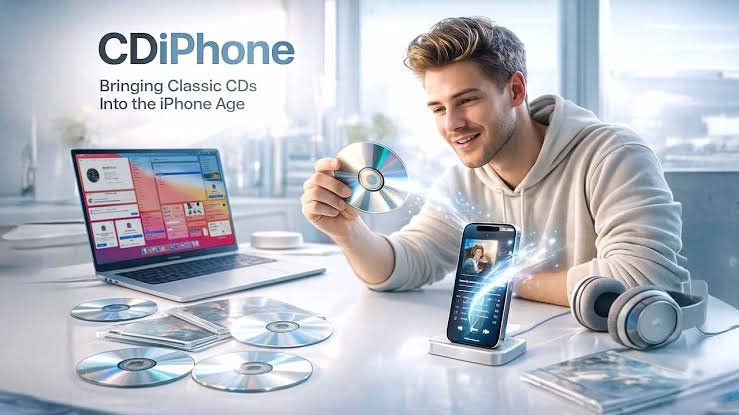
Technology has a funny way of bringing old ideas back into the conversation. CDs were once the standard way to buy and store music, while the iPhone helped move personal music collections toward digital libraries and streaming.
That combination helps explain why people searching for a cdiphone can find very different explanations online.
The important thing to know is that CDiPhone is not an official Apple product name. There is no confirmed Apple device sold under the name “CDiPhone.” Instead, the term is commonly used online as a shorthand for ideas involving CDs and iPhones, especially the process of getting music from a physical CD onto an iPhone.
This guide separates the real technology from the speculation and explains the practical ways to enjoy your CD collection on an iPhone.
What Is a CDiPhone?
CDiPhone is an unofficial internet term rather than a recognized Apple product, technology, or iPhone model. In most online discussions, it describes the connection between compact-disc music and modern iPhones.
The term can be understood in a few ways:
- A concept combining CD technology with an iPhone
- A way of transferring music from CDs to an iPhone
- A general discussion about bringing physical music collections into a modern digital library
- In some cases, simply an ambiguous or incorrectly interpreted search term
Because there is no standardized technical definition, the meaning depends heavily on the context in which you encounter it.
For most users, the practical question behind the term is much simpler: “How can I get the music from my CDs onto my iPhone?”
Fortunately, that is possible using a computer and Apple’s music-management and syncing tools.
Is the CDiPhone a Real Apple Product?
No. The CDiPhone is not an officially announced Apple product.
Apple’s official documentation covers iPhone, Apple Music, Apple Devices, Finder, and other established products and services, but it does not identify “CDiPhone” as a separate Apple device. Apple’s current documentation explains how users can sync music between computers and iPhones instead.
This distinction matters because some websites present the CDiPhone as though it were a commercially available smartphone with a built-in CD drive.
There is currently no reliable basis for treating that claim as an official Apple product announcement.
CDiPhone vs. a Regular iPhone
| Feature | CDiPhone term | Modern iPhone |
| Official Apple product | No | Yes |
| Built-in CD drive | No confirmed device | No |
| Digital music playback | Conceptual | Yes |
| CD music transfer | Refers to a workflow | Possible through a computer |
| Apple Music support | Not applicable | Yes |
| Official Apple documentation | None for CDiPhone | Extensive |
Why Are People Searching for a CDiPhone?
The unusual term naturally creates curiosity.
Someone might see “CDiPhone” in an article, forum, social post, or search result and assume Apple has introduced a new product. Others may simply be looking for a way to preserve an old CD collection while moving to a smartphone.
There is also a nostalgic element. CDs still matter to collectors because physical albums can provide:
- Personal ownership of a physical copy
- Album artwork and booklets
- Offline listening
- Access to music that may not be available on every streaming service
- A tangible connection to a music collection
The growth of digital music hasn’t necessarily eliminated interest in physical media. Instead, many people now use both.
What Does a CDiPhone Usually Refer To?
1. CD-to-iPhone Music Transfer
This is the most practical interpretation.
The process involves taking music from a CD, importing it into a computer, organizing the resulting audio files, and then syncing those files to an iPhone.
Apple’s current Windows documentation supports importing audio files into the Apple Music app and syncing music from a Windows computer to an iPhone through the Apple Devices app.
2. A Conceptual CD Smartphone
Some websites use CDiPhone to describe a hypothetical phone that combines modern smartphone features with physical-disc technology.
It’s an interesting idea, but it should be treated as a concept, not an established Apple product.
A built-in CD mechanism would also create practical challenges. Optical drives require physical space and moving components, while modern smartphones prioritize thin designs, battery efficiency, durability, and wireless connectivity.
3. An Ambiguous Search Term
Some people may encounter a CDiPhone through unrelated technical discussions or third-party websites.
That is why it is better not to assume that every mention has the same meaning. If the term appears in a specific app, error message, website, or device setting, the surrounding context is important.
How to Transfer CD Music to an iPhone
If your real goal is to put music from your CDs on an iPhone, you don’t need a special “CDiPhone” device.
You need a computer with a CD drive or compatible external optical drive, music-management software, and your iPhone.
Step 1: Import the CD to Your Computer
Insert the audio CD into your computer’s optical drive.
Use your music application to import or “rip” the tracks into digital audio files.
Before starting a large collection, check the import settings and choose an audio format that fits your needs.
Step 2: Check the Track Information
After importing, review:
- Artist name
- Album title
- Track names
- Track numbers
- Album artwork
- Genre
Good metadata makes a large music collection much easier to navigate later.
Step 3: Add the Music to Your Library
On Windows, Apple says the Apple Music app can import audio files or folders from your computer.
This gives you a central library where you can organize your CD collection before transferring it to your iPhone.
Step 4: Sync the Music to Your iPhone
For Windows, Apple’s current instructions use the Apple Devices app for syncing music, while the Apple Music app manages the music library. You can connect the iPhone using USB/USB-C or use supported Wi-Fi syncing.
On a Mac, Finder can be used to select the iPhone, choose Music, enable music syncing, and apply the changes.
Step 5: Test a Few Albums First
If you’re transferring hundreds of tracks, don’t start with your entire collection.
Test one or two albums first.
Check that:
- Songs play correctly.
- Album artwork appears properly.
- Track names are correct.
- The music is stored where you expect it.
- Your iPhone has enough available storage.
Once everything works, transfer the remaining collection.
CD Music and Audio Quality
Audio quality depends on how you import and store the music.
A lossless format preserves the audio information without the data reduction associated with lossy compression. Lossy formats can create smaller files but may discard some audio information.
For casual listening, smaller files can be convenient. For people building a long-term digital archive, a lossless master may make more sense.
A useful approach is to keep a well-organized master library on your computer and create suitable copies for everyday listening.
Don’t assume that a larger file automatically sounds better, though. Your source material, playback equipment, encoding settings, and listening environment all matter.
Common CDiPhone Misunderstandings
“CDiPhone is Apple’s New Phone”
There is no reliable evidence that the CDiPhone is an official Apple phone.
“An iPhone Can Read a CD Directly”
An iPhone does not function like a traditional CD player with a built-in optical disc drive.
For CD music, the practical route is to use a computer or another supported method to digitize the audio first.
“CDiPhone Is an Official App”
There is no established Apple app officially named CDiPhone.
Be cautious if a website asks you to install unknown software claiming to be an official CDiPhone utility.
“You Need a Special CDiPhone Converter”
You don’t need a product specifically called CDiPhone to transfer your legally obtained CD music. Apple’s documented computer-sync workflows already provide the basic infrastructure for moving music to an iPhone.
Is Using CD Music on an iPhone Worth It?
For people with a large CD collection, it can be very worthwhile.
Advantages
- Your existing music becomes portable.
- You can listen without carrying physical discs.
- You can organize albums and playlists digitally.
- Rare or older albums can remain part of your personal library.
- You can keep a personal archive instead of relying entirely on streaming availability.
Potential Drawbacks
- Initial CD importing takes time.
- Large collections require storage.
- Metadata may need manual correction.
- A computer is generally needed for a traditional CD-to-iPhone workflow.
- Copyright rules vary by country, so users should make sure their copying and use of music comply with applicable laws.
Key Takeaways
- The CDiPhone is not an official Apple product.
- The term is generally used online for concepts or workflows connecting CDs and iPhones.
- The most useful interpretation is transferring CD music into an iPhone-compatible digital library.
- Apple supports importing music into its computer-based music library and syncing music to iPhone.
- Mac users can use Finder for music syncing, while Windows users can use Apple Music and Apple Devices.
- Be skeptical of websites claiming that the CDiPhone is a newly released Apple device.
FAQs
1. What is a CDiPhone?
CDiPhone is an unofficial term found online. It generally refers to concepts connecting compact-disc music with iPhones, particularly transferring music from CDs to an iPhone.
2. Is the CDiPhone made by Apple?
No. CDiPhone is not an officially recognized Apple product or iPhone model.
3. Can I put CD music on my iPhone?
Yes. You can import music from CDs to a computer and then sync the music to an iPhone using Apple’s supported tools.
4. Does an iPhone have a CD drive?
No. Modern iPhones don’t include a built-in optical CD drive. CD audio therefore needs to be digitized before conventional transfer to the phone.
5. Can Windows users transfer CD music to an iPhone?
Yes. Apple provides a Windows workflow involving the Apple Music app for managing music and the Apple Devices app for syncing music to an iPhone.
6. Can Mac users transfer CD music to an iPhone?
Yes. After importing the music into the Mac’s music library, Finder can be used to sync selected music with an iPhone.
7. Is CDiPhone a new type of smartphone?
There is no confirmed Apple smartphone officially called CDiPhone. Websites describing such a device should be treated as discussing a concept unless they provide credible manufacturer documentation.
Conclusion
The term cdiphone sounds like the name of a new gadget, but the reality is much less mysterious. It isn’t an official Apple product or recognized iPhone model. Instead, the term is mainly used online to describe ideas surrounding CDs, iPhones, and the transition from physical music to digital listening.
For someone with a shelf full of CDs, the useful takeaway is simple: you don’t need a special CD-enabled iPhone. You can digitize your music on a computer, organize the library, and use Apple’s supported syncing options to bring that collection onto your iPhone.
That approach gives you something the original CD player couldn’t: your familiar collection in a portable digital library that fits into the way people listen to music today.
Learn About: WYF Meaning
