

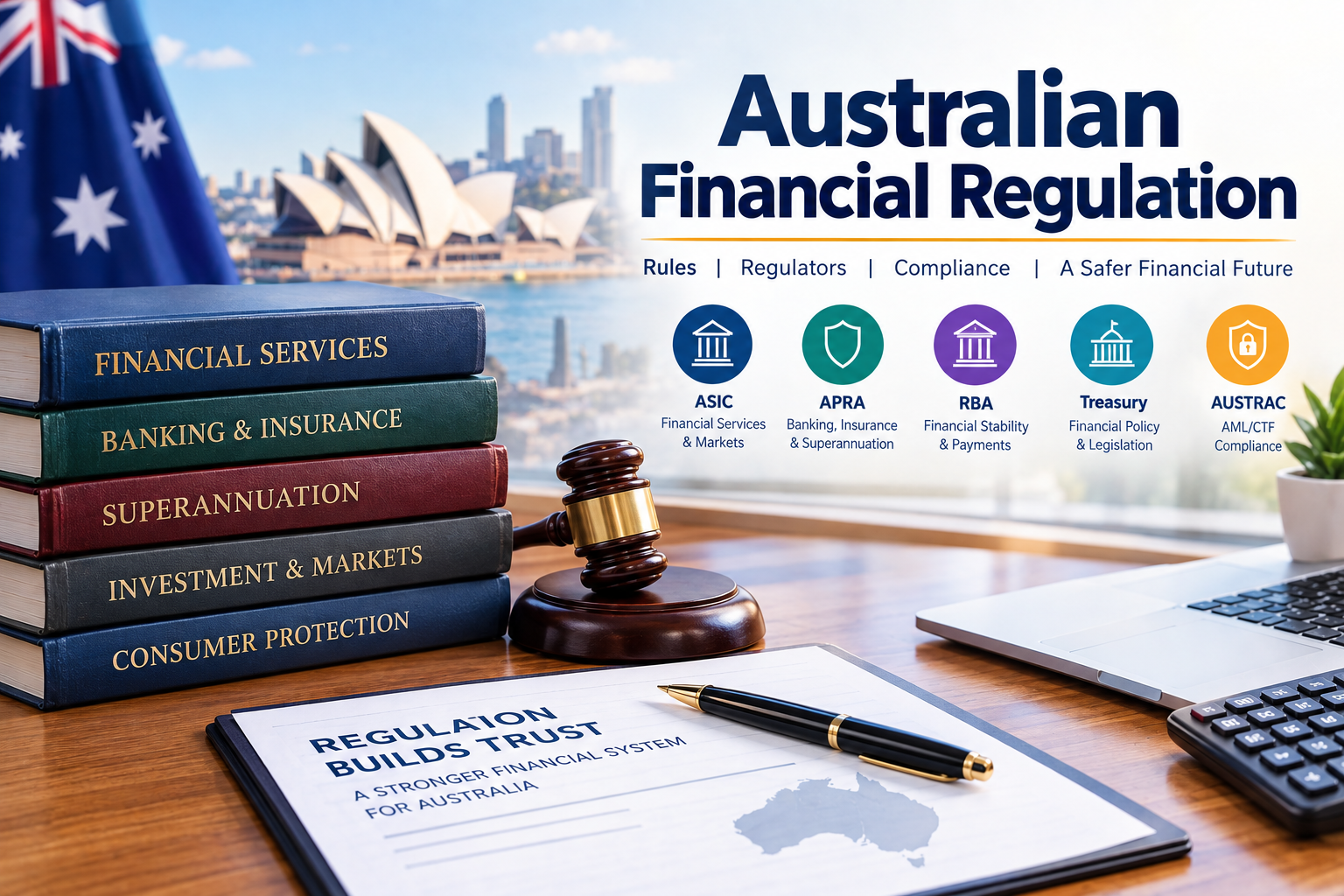
Australia has a broad financial regulatory framework designed to support financial stability, protect consumers, maintain market integrity, and supervise financial institutions. Rather than relying on one regulator, Australia uses a coordinated system in which different agencies have specific responsibilities.
For businesses operating in banking, investment, insurance, superannuation, credit, payments, or financial services, understanding these responsibilities is essential. Licensing, disclosure, consumer protection, prudential requirements, and anti-money laundering obligations can all apply depending on the type of activity a business performs.
This guide explains how Australian financial regulation works, which agencies are involved, the major laws businesses should know, and what compliance can mean in practice.
What Is Australian Financial Regulation?
Australian financial regulation refers to the laws, regulatory standards, licensing arrangements, supervision, and enforcement mechanisms that govern financial activities in Australia.
The framework covers a wide range of activities, including:
- Banking and deposit-taking
- Financial advice
- Investment products
- Insurance
- Superannuation
- Consumer credit
- Financial markets
- Payment systems
- Corporate financial services
- Anti-money laundering and counter-terrorism financing
Different regulators have different responsibilities. This means a single financial business may need to comply with requirements administered by more than one authority.
The Council of Financial Regulators (CFR) helps coordinate Australia’s major financial regulators. Its members are the RBA, APRA, ASIC, and Treasury.
Who Regulates the Australian Financial System?
Australia’s financial regulatory structure involves several important government agencies.
| Regulator | Main Area of Responsibility |
|---|---|
| ASIC | Financial services, corporations, markets, consumer credit and consumer protection |
| APRA | Prudential supervision of banks, insurers and superannuation institutions |
| RBA | Financial system stability, payments system and clearing and settlement infrastructure |
| Treasury | Financial policy and advice to government |
| AUSTRAC | Anti-money laundering and counter-terrorism financing |
The regulators cooperate while maintaining separate statutory responsibilities. APRA describes Australia’s wider financial system as being overseen by five regulators, including ASIC, APRA, RBA, ACCC and AUSTRAC.
Key Australian Financial Regulators
Australian Securities and Investments Commission (ASIC)
ASIC is responsible for regulating corporations, financial services, markets, and consumer credit activities.
It licenses and monitors financial services businesses and works to promote fair and transparent markets and consumer protection. ASIC’s financial services framework covers products such as securities, derivatives, insurance, superannuation, deposit accounts, and other financial products.
For businesses providing regulated financial services, ASIC licensing and ongoing obligations can be central to compliance.
Australian Prudential Regulation Authority (APRA)
APRA focuses on prudential supervision. Its responsibilities include supervising banks and other authorised deposit-taking institutions, insurers, and superannuation funds.
The objective is to support the safety and stability of institutions and protect the interests of depositors, policyholders, and superannuation members.
Reserve Bank of Australia (RBA)
The RBA is Australia’s central bank and has important financial stability responsibilities.
Its regulatory responsibilities include the payments system and supervision of certain clearing and settlement facilities. It also provides liquidity to the financial system and contributes to financial crisis management.
The RBA works with APRA, ASIC, and Treasury through the Council of Financial Regulators.
Australian Treasury
Treasury advises the Australian Government on economic and financial policy, including the legislative and regulatory framework for the financial system.
Treasury also publishes the Regulatory Initiatives Grid, which provides information about announced and publicised financial-sector regulatory reforms and initiatives.
AUSTRAC
AUSTRAC is Australia’s financial intelligence unit and AML/CTF regulator.
Businesses covered by Australia’s anti-money laundering and counter-terrorism financing framework may have obligations relating to customer identification, risk management, reporting, record keeping, and other compliance controls.
AUSTRAC notes that its guidance explains how it interprets relevant legislation and rules, while Australian courts ultimately determine whether legal provisions have been contravened.
Major Financial Regulations and Laws
Australian financial regulation is based on several major pieces of legislation and regulatory frameworks.
Corporations Act 2001
The Corporations Act 2001 is one of the central laws governing financial services and corporations in Australia.
It establishes important requirements concerning financial services, licensing, financial product advice, dealing in financial products, market-making, managed schemes, custody and other regulated activities.
Under section 911A, businesses generally need an Australian financial services licence when carrying on a financial services business in Australia, subject to applicable exceptions.
National Consumer Credit Protection Act 2009
Consumer credit activities are regulated under the National Consumer Credit Protection Act 2009.
The legislation generally requires people or businesses engaging in regulated credit activities to hold an Australian credit licence, subject to specific exceptions.
This framework is relevant to areas such as:
- Consumer lending
- Mortgage broking
- Credit assistance
- Finance businesses
- Credit-related services
AML/CTF Legislation
Anti-money laundering and counter-terrorism financing requirements are another important part of Australian financial regulation.
Businesses covered by the AML/CTF framework must understand their obligations and maintain appropriate compliance systems. AUSTRAC administers and supervises the relevant framework.
Australian Financial Services Licensing
An Australian financial services licence, commonly called an AFSL, is an important requirement for businesses conducting regulated financial services activities.
Depending on the business model, regulated services can include:
- Providing financial product advice
- Dealing in financial products
- Operating certain managed investment schemes
- Providing custodial or depository services
- Certain claims-handling services
- Certain superannuation trustee services
The Corporations Act establishes the licensing framework, while ASIC administers financial services licensing and supervision.
Businesses considering an AFSL should determine exactly which financial services they provide and whether exemptions or specific licensing arrangements apply.
Consumer Credit Regulation in Australia
Financial regulation also protects consumers in the credit market.
ASIC regulates consumer credit activities and licenses businesses involved in areas such as banking, finance, mortgage broking, and related credit services. Licensees must meet requirements under the National Consumer Credit Protection Act 2009.
For example, a mortgage broker operating in Australia may need to consider licensing requirements, responsible conduct obligations, consumer protections, record keeping, and dispute resolution arrangements.
The exact obligations depend on the activities and business structure involved.
Why Australian Financial Regulation Matters
Effective financial regulation serves several important purposes.
1. Protecting Consumers
Consumers need reliable information when making financial decisions. Regulation establishes requirements around financial services, disclosure, conduct, and consumer protection.
2. Supporting Financial Stability
Prudential supervision and financial stability measures help regulators identify and manage risks that could affect financial institutions or the wider financial system.
3. Maintaining Market Integrity
Financial markets depend on confidence, transparency, and orderly operation. ASIC plays an important role in regulating financial markets and promoting market integrity.
4. Reducing Financial Crime
AML/CTF requirements help regulated businesses identify and manage risks associated with money laundering and terrorism financing.
5. Establishing Accountability
Licensing and supervisory requirements create standards that regulated businesses must meet and maintain.
How Businesses Can Stay Compliant
Financial regulation can be complex, particularly for businesses operating across multiple financial activities.
A practical compliance approach includes:
- Identify regulated activities
Determine exactly what financial services, credit activities, or products the business provides. - Identify the relevant regulators
Establish whether ASIC, APRA, AUSTRAC, RBA, or another authority has responsibility for the relevant activity. - Check licensing requirements
Determine whether an AFSL, Australian credit licence, registration, or another authorisation is required. - Understand ongoing obligations
Licensing is not the end of compliance. Businesses may have continuing obligations relating to conduct, disclosure, reporting, record keeping, governance, and risk management. - Monitor regulatory changes
Financial rules can change. Treasury’s Regulatory Initiatives Grid is one source businesses can use to monitor announced financial-sector reforms. - Seek professional advice when necessary
Because regulatory obligations can depend on specific facts and business structures, regulated businesses should obtain appropriate legal or compliance advice when needed.
Key Takeaways
- Australian financial regulation covers financial services, banking, insurance, superannuation, credit, markets, payments, and financial crime controls.
- ASIC is a major regulator for financial services, corporations, markets, and consumer credit.
- APRA focuses on prudential supervision of banks, insurers, and superannuation institutions.
- The RBA contributes to financial stability and regulates important parts of the payments system.
- Treasury advises the government on financial policy and the regulatory framework.
- AUSTRAC administers Australia’s AML/CTF regulatory framework.
- The Corporations Act 2001 provides a major foundation for financial services regulation.
- Consumer credit activities are regulated under the National Consumer Credit Protection Act 2009.
- Licensing and ongoing compliance requirements depend on the specific activities a business performs.
FAQs About Australian Financial Regulation
1. What is Australian financial regulation?
Australian financial regulation is the framework of laws, regulatory agencies, licensing requirements, standards, and supervisory arrangements governing Australia’s financial sector.
2. Who regulates financial services in Australia?
ASIC is the principal regulator for many financial services and markets, while APRA supervises the prudential safety of banks, insurers, and superannuation institutions. Other responsibilities are handled by the RBA, Treasury, AUSTRAC, and other regulators depending on the activity.
3. What is an Australian financial services licence?
An Australian financial services licence, or AFSL, authorises a business to provide specified regulated financial services in Australia, subject to its licence conditions and ongoing legal obligations.
4. Does every financial business need an AFSL?
Not necessarily. The requirement depends on the activities the business performs and whether an applicable exemption or alternative regulatory arrangement applies. Businesses should assess their specific circumstances against the relevant legislation.
5. What does APRA regulate?
APRA primarily supervises banks and other authorised deposit-taking institutions, insurers, and superannuation institutions from a prudential perspective.
6. What does ASIC regulate?
ASIC regulates and supervises corporations, financial services, financial markets, and consumer credit activities. It also has important responsibilities for market integrity and consumer protection.
7. What is the role of AUSTRAC?
AUSTRAC is Australia’s AML/CTF regulator and financial intelligence unit. It supervises entities covered by the relevant AML/CTF framework and provides guidance on compliance obligations.
8. Why should businesses monitor financial regulatory changes?
Regulatory requirements can change over time. Monitoring developments helps businesses identify new obligations, implementation dates, and changes that may affect their operations.
Conclusion
Australian financial regulation is a broad and coordinated framework involving multiple regulators, laws, licensing systems, and supervisory requirements. ASIC, APRA, the RBA, Treasury, and AUSTRAC each have distinct responsibilities, while the Council of Financial Regulators supports coordination among key agencies.
For businesses, compliance starts with understanding which activities are regulated, identifying the relevant authority, checking licensing requirements, and maintaining appropriate systems for ongoing obligations. Because the applicable rules depend on the nature of a business and its activities, organisations should use current regulator guidance and obtain professional advice where specific legal interpretation is required.
Learn About: Social Class and Socioeconomics
