

Every day, people use search engines to find answers, products, services, news, businesses, and educational resources. You may search for a recipe, compare a product, look for a local service, or research a complicated subject. Behind every search is a sophisticated system designed to connect users with useful information.
Understanding search engine basics is important for anyone who owns a website, works in digital marketing, or simply wants to understand how online search works.
Search engines don’t manually review every website. Instead, automated systems discover web pages, analyze their content, store information about them, and determine which results are most relevant to a user’s query.
This guide explains how search engines work, what crawling and indexing mean, how ranking works, and how website owners can create content that is useful for both visitors and search engines.
Table of Contents
- What Is a Search Engine?
- How Do Search Engines Work?
- Crawling, Indexing, and Ranking
- Understanding Search Intent
- Organic Search vs. Paid Search
- Why SEO Matters
- How to Make a Website Search-Friendly
- Common Search Engine Mistakes
- Key Takeaways
- FAQs
What Is a Search Engine?
A search engine is an online system that helps people find information across the internet. It receives a user’s search query and returns a collection of results that may answer or satisfy that query.
Google is the best-known example, but other search engines include Bing, DuckDuckGo, Yahoo, Baidu, and Yandex.
Search engines use automated programs and complex ranking systems to process enormous amounts of information. Their goal is to help users find relevant and useful results as efficiently as possible.
For example, if someone searches for “best ways to improve website speed,” the search engine tries to return pages that provide practical information about website performance rather than pages that simply repeat the phrase several times.
How Do Search Engines Work?
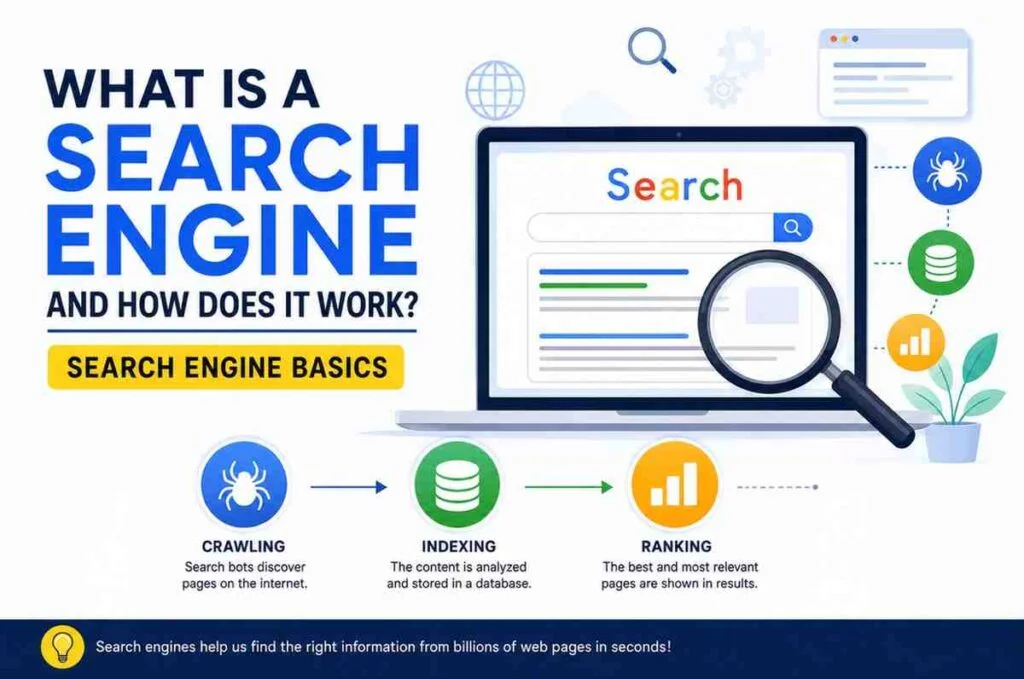
The basic search process can be divided into three major stages:
- Crawling
- Indexing
- Ranking
These processes work together to help search engines discover content and deliver relevant results.
1. Crawling
Crawling is the process of discovering web pages. Search engines use automated programs called crawlers, bots, or spiders to visit websites and follow links from one page to another.
A crawler may discover a new page through:
- Internal links
- Links from other websites
- XML sitemaps
- Previously discovered URLs
- Other available discovery methods
Crawling does not necessarily mean that a page will appear in search results. A search engine may discover a page but decide not to index it.
2. Indexing
After a search engine discovers a page, it analyzes the information available on that page. If the page is eligible for indexing, information about it may be stored in the search engine’s index.
The index is essentially a huge collection of information about web content.
Search engines can process elements such as:
- Text and headings
- Images
- Links
- Page titles
- Structured data
- Language
- Canonical information
- Other page signals
When a user performs a search, the search engine can use this stored information to identify potentially relevant pages.
3. Ranking
Ranking is the process of deciding which results should appear and in what order for a particular search.
Search engines use many signals and systems to evaluate relevance, quality, context, and other factors.
The exact factors and their importance can vary depending on the search. For example, a query about breaking news may require fresh information, while a historical question may benefit from established reference material.
This is why there isn’t one simple formula that guarantees a particular position in search results.
Understanding Search Intent
Search intent refers to what a person actually wants when they enter a query into a search engine.
Understanding intent is an important part of creating useful content.
Common types of search intent include:
| Intent | Purpose | Example |
| Informational | Learn something | “What is SEO?” |
| Navigational | Find a specific website | “Facebook login” |
| Commercial | Research options | “Best SEO tools” |
| Transactional | Buy or complete an action | “Buy running shoes” |
| Local | Find something nearby | “Coffee shop near me” |
For example, someone searching for “search engine basics” probably wants a beginner-friendly explanation of how search engines work. A useful article should therefore explain crawling, indexing, ranking, search queries, and related SEO concepts.
Simply mentioning the keyword repeatedly would not satisfy the searcher’s needs.
Organic Search vs. Paid Search
Search engine results can include both organic listings and advertisements.
Organic Results
Organic results are unpaid listings selected by a search engine’s ranking systems. Websites can improve their chances of earning organic visibility through SEO, useful content, technical improvements, and other legitimate practices.
However, no legitimate SEO strategy can guarantee a specific organic ranking.
Paid Results
Paid search results are advertisements. Businesses pay advertising platforms to show promotional messages for particular searches, audiences, or conditions.
SEO and paid search can work together, but they serve different purposes. SEO focuses on earning organic visibility, while paid search involves purchasing advertising placements.
Why SEO Matters
Search engine optimization, commonly known as SEO, helps websites become easier for search engines to discover, understand, and present to relevant users.
SEO includes several areas.
On-Page SEO
On-page SEO focuses on elements found directly on a webpage, such as:
- Page titles
- Headings
- Main content
- Internal links
- Images and alt text
- URLs
- Content structure
- Search intent
Technical SEO
Technical SEO focuses on the technical aspects that affect crawling, indexing, and website usability.
It can include:
- Mobile usability
- Website architecture
- XML sitemaps
- Canonical URLs
- Redirects
- HTTPS
- Structured data
- Page performance
Off-Page SEO
Off-page SEO includes activities outside your website. Link building is one example. Relevant, trustworthy links can help search engines discover content and may contribute to how a website’s reputation and relevance are understood.
The focus should be on quality and relevance rather than manipulating rankings with excessive or unnatural links.
How to Make a Website Search-Friendly
Website owners can follow several basic practices to create a better search experience.
Create Helpful Content
Write content that genuinely answers the questions your audience has. Avoid adding unnecessary information just to increase word count.
Use Clear Headings
Organize content with descriptive headings and subheadings. This makes longer pages easier to scan and understand.
Improve Internal Linking
Link related pages where it helps readers find additional information. A logical internal linking structure can also help search engines understand your website.
Make Your Website Mobile-Friendly
Many people access websites through smartphones. Pages should be easy to read, navigate, and interact with on smaller screens.
Keep Information Accurate
Review important content regularly, especially when information can change over time. Accurate information helps establish trust with readers.
Monitor Technical Problems
Check for broken links, indexing issues, inaccessible pages, incorrect redirects, and other technical problems that may prevent users or search engines from accessing important content.
Common Search Engine Mistakes
Some websites make the mistake of focusing more on search engines than their actual visitors.
Common problems include:
- Keyword stuffing
- Publishing copied content
- Creating thin pages with little useful information
- Using misleading titles
- Building manipulative backlinks
- Ignoring mobile users
- Publishing outdated information
- Creating content solely to attract search traffic
A better approach is to start with the user’s needs. Once the purpose of a page is clear, optimize it naturally without sacrificing readability or usefulness.
Key Takeaways
- Search engines help users discover information online.
- Crawling, indexing, and ranking are the basic stages of search.
- Crawlers discover pages and follow links across websites.
- Indexing involves processing and storing information about web pages.
- Ranking determines which relevant results are presented to users.
- Search intent explains what users are trying to accomplish.
- SEO helps websites improve their visibility and accessibility.
- Helpful, accurate, original content should be created for people first.
- Technical SEO and good website usability are important parts of a strong search strategy.
FAQs
What are the basics of a search engine?
The basic search engine process involves crawling web pages, indexing their information, and ranking relevant pages for a user’s search query.
What are the three main processes of search engines?
The three main processes are crawling, indexing, and ranking. Crawling discovers content, indexing stores and processes information, and ranking determines which results are most relevant.
What is search engine optimization?
Search engine optimization, or SEO, is the practice of improving a website’s content, structure, technical accessibility, and overall quality to help it earn relevant organic search visibility.
Does keyword stuffing improve rankings?
No. Repeating keywords excessively does not guarantee better rankings and can make content difficult to read. Keywords should be used naturally where they help explain the topic.
Can a new website rank on search engines?
Yes. New websites can appear in search results, although building organic visibility may take time. Useful content, good technical foundations, and a strong website structure can support long-term growth.
What is the difference between a browser and a search engine?
A browser is software used to access websites, while a search engine helps users find information and websites online. Chrome is an example of a browser, while Google is a search engine.
Conclusion
Understanding search engine basics helps website owners and marketers learn how search engines discover, index, and rank content. A successful SEO strategy starts with creating useful, accurate, and original content that matches user search intent. Clear headings, relevant keywords, internal links, mobile-friendly design, and good website structure can also improve the overall experience. SEO isn’t about keyword stuffing or shortcuts. It’s about helping users find valuable information while making your website easy for search engines to understand. By focusing on quality, relevance, and user needs, businesses can build a stronger online presence and improve their chances of gaining long-term organic search visibility.
Learn About: Pabington
