

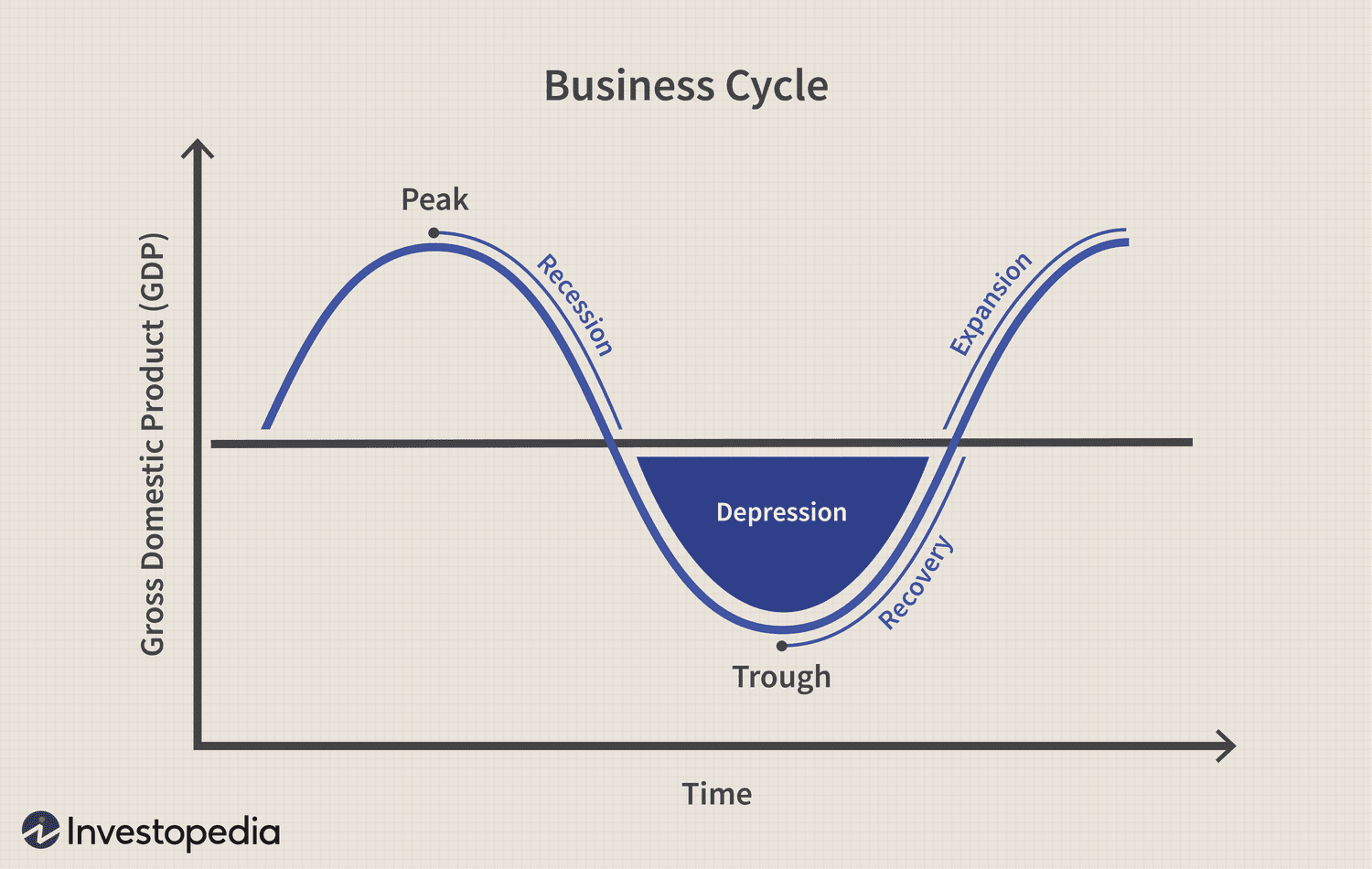
The business cycle describes the recurring pattern of expansion and contraction in economic activity. Economies do not grow at exactly the same pace year after year. Periods of rising production, employment, income, and consumer spending can eventually slow down, while weaker periods may later give way to renewed growth.
Understanding the business cycle helps businesses, investors, policymakers, and individuals make better sense of changes in the economy. Although each cycle is different, economists generally describe it through several stages: expansion, peak, contraction, and trough. The timing and intensity of these stages can vary significantly.
What Is the Business Cycle?
The business cycle is the fluctuation of economic activity around a long-term growth trend. It reflects changes in measures such as gross domestic product (GDP), employment, income, industrial production, business investment, and consumer spending.
During an expansion, economic activity generally increases. Businesses may produce more goods and services, hire additional workers, and invest in new facilities or technology. During a contraction, economic activity slows, and businesses may reduce production, hiring, or investment.
The cycle does not follow a perfectly predictable schedule. Some expansions last for years, while contractions can be relatively brief or become more severe depending on economic conditions.
The Four Main Stages of the Business Cycle
Economists commonly divide the business cycle into four major stages: expansion, peak, contraction, and trough.
1. Expansion
Expansion is the phase in which economic activity increases.
Businesses often experience stronger demand for their products and services, which can encourage them to increase production and hire more employees. Household incomes may rise as employment opportunities improve, potentially supporting higher consumer spending.
During an expansion, businesses may also increase capital investment because they expect continued demand. Credit conditions, interest rates, consumer confidence, government policies, and technological developments can all influence the strength of an expansion.
However, rapid growth can sometimes create pressures such as rising prices, shortages of labor or materials, and increasing borrowing costs.
2. Peak
The peak represents the point at which economic activity reaches a temporary high before growth begins to slow.
At this stage, production and employment may be relatively strong, but signs of an approaching slowdown can begin to appear. Demand may stop increasing as quickly, businesses may become more cautious about investment, or financial conditions may become tighter.
A peak does not necessarily mean that the economy immediately enters a severe downturn. It marks a turning point between an expansion and a contraction.
3. Contraction
A contraction occurs when overall economic activity declines.
Businesses may face weaker demand and respond by reducing production, delaying investment, or slowing hiring. Employment conditions can deteriorate, while consumers may become more cautious about major purchases.
A particularly severe and prolonged contraction is commonly called a recession. During a recession, economic weakness can affect many parts of the economy, including households, businesses, financial markets, and government revenues.
The causes of contractions differ from one cycle to another. Financial crises, falling demand, supply disruptions, high borrowing costs, asset-price declines, and major external shocks can all contribute.
4. Trough
The trough is the lowest point of a contraction before economic activity begins to recover.
At the trough, economic conditions may still be weak, but the decline has reached a turning point. As demand improves and businesses regain confidence, production and employment can begin to recover.
The economy then moves toward a new expansion, beginning another phase of the business cycle.
What Causes the Business Cycle?
There is no single cause behind every business cycle. Economic fluctuations usually result from a combination of factors.
Changes in Consumer Spending
Consumer spending is a major part of economic activity. When households feel confident about their income and financial situation, they may spend more. Stronger demand can encourage businesses to increase production and hiring.
When consumers become cautious, spending can weaken, reducing demand for goods and services.
Business Investment
Companies regularly make decisions about factories, equipment, technology, inventories, and employees. Higher expected demand can encourage investment, while uncertainty or weaker sales expectations can cause businesses to postpone expansion.
Because investment can change significantly when expectations shift, it can contribute to economic fluctuations.
Interest Rates and Credit Conditions
Borrowing costs influence households and businesses. Lower interest rates can make borrowing more affordable, potentially supporting spending and investment.
Higher interest rates can make loans more expensive and may reduce demand for homes, vehicles, business investment, and other purchases.
Government Policies
Fiscal and monetary policies can influence economic activity. Government spending, taxation, and central-bank decisions can affect demand, borrowing conditions, employment, and inflation.
The effects depend on the broader economic environment and the specific policies being implemented.
External Shocks
Unexpected events can also disrupt economic activity. Examples include major natural disasters, geopolitical disruptions, financial crises, pandemics, or significant supply-chain problems.
Such events can affect production, transportation, consumer behavior, commodity prices, and international trade.
How the Business Cycle Affects Businesses
Different businesses experience economic cycles in different ways.
During an expansion, companies may benefit from stronger customer demand and greater opportunities for growth. Businesses may hire additional employees, increase inventory, open new locations, or invest in new products.
During a contraction, companies may need to focus more closely on cash flow and operating costs. Businesses selling nonessential products can be particularly sensitive to changes in consumer spending, while some essential industries may experience more stable demand.
Understanding economic conditions can therefore help companies plan budgets, manage inventory, evaluate investments, and prepare for changing demand.
How the Business Cycle Affects Consumers
The business cycle can influence everyday financial decisions.
During strong economic periods, employment opportunities and household incomes may improve. People may feel more comfortable making major purchases or taking on long-term financial commitments.
During weaker periods, job security may become more uncertain. Consumers may reduce discretionary spending, increase savings, or postpone large purchases.
The effects are not identical for everyone. Individual circumstances, industry, location, income, and financial resources can determine how strongly someone experiences an economic downturn or expansion.
How Is the Business Cycle Measured?
Economists use several indicators to assess economic activity and identify changes in the business cycle.
Important measures include:
- Real GDP: Measures the inflation-adjusted value of goods and services produced in an economy.
- Employment: Shows changes in jobs and labor-market conditions.
- Industrial production: Tracks activity in sectors such as manufacturing, mining, and utilities.
- Consumer spending: Provides information about household demand.
- Business investment: Shows how companies are spending on equipment, structures, technology, and other productive assets.
- Income: Changes in personal and business income can provide information about economic conditions.
No single indicator provides a complete picture. Economists generally examine several measures together when evaluating whether an economy is expanding or contracting.
Business Cycle vs. Economic Growth
The business cycle and long-term economic growth are related but different concepts.
Economic growth refers to an economy’s increase in productive capacity and output over the long term. Growth can result from factors such as technological progress, population changes, improved skills, capital investment, and greater productivity.
The business cycle, on the other hand, describes shorter-term fluctuations around that longer-term growth path.
An economy can experience temporary contractions while still maintaining positive long-term growth over many years.
Why Understanding the Business Cycle Matters
The business cycle matters because economic conditions influence decisions made by businesses, governments, investors, and households.
Businesses can use information about economic conditions when planning hiring, inventory, investment, and expansion. Governments and central banks monitor economic activity when developing policies. Individuals may consider broader economic conditions when thinking about employment, spending, saving, or major financial commitments.
However, the business cycle should not be treated as a perfectly predictable calendar. Economic turning points can be difficult to identify in real time, and unexpected events can change the direction of economic activity.
Frequently Asked Questions
What is the business cycle in simple terms?
The business cycle is the pattern of rising and falling economic activity over time. It generally includes expansion, peak, contraction, and trough.
What are the four stages of the business cycle?
The four commonly identified stages are expansion, peak, contraction, and trough. Together, they describe the movement from increasing economic activity to a slowdown and eventual recovery.
Is a recession the same as a contraction?
A recession is a significant period of economic decline. Contraction is the broader term for a decline in economic activity, while a severe or prolonged contraction may be described as a recession depending on the definition being used.
What causes a business cycle?
Business cycles can result from changes in consumer spending, business investment, interest rates, credit conditions, government policies, financial conditions, and unexpected external shocks.
How does the business cycle affect employment?
Employment often strengthens during economic expansions as businesses respond to higher demand. During contractions, weaker demand can lead companies to reduce hiring or, in some cases, cut jobs.
Can the business cycle be predicted?
Economic indicators can help economists assess current conditions and identify potential changes, but the exact timing and severity of future expansions or contractions cannot be predicted with certainty.
Why should businesses monitor the business cycle?
Monitoring economic conditions can help businesses make informed decisions about hiring, investment, inventory, pricing, budgeting, and expansion.
Conclusion
The business cycle is a fundamental concept for understanding how economic activity changes over time. Expansions can bring stronger production, employment, income, and spending, while contractions can create weaker demand and greater financial uncertainty. Peaks and troughs represent important turning points between these phases.
Although every cycle is different, monitoring indicators such as GDP, employment, consumer spending, investment, and income can provide valuable insight into the state of the economy. For businesses and individuals alike, understanding these patterns can make economic changes easier to interpret and prepare for.
Learn More About: Business Analysis
