

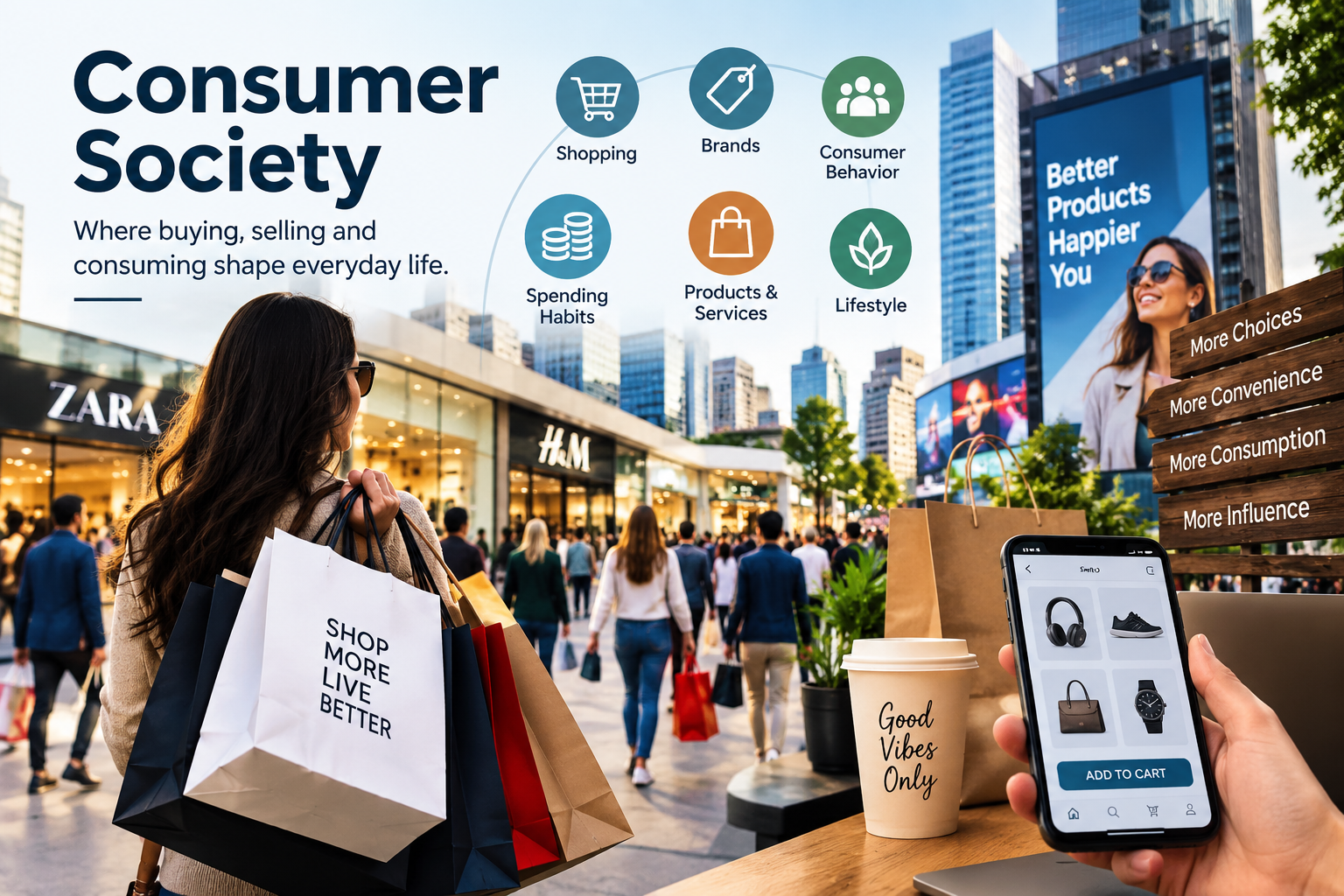
A consumer society is a social and economic system in which the purchase and use of goods and services have a significant influence on people’s daily lives. Consumption is not limited to basic needs such as food, clothing, or housing. People may also purchase products for convenience, entertainment, status, self-expression, comfort, or personal satisfaction.
In a consumer society, products can become closely connected with identity and lifestyle. The clothes someone wears, the phone they use, the car they drive, or the places they visit may communicate something about their interests and social position.
Consumer societies are closely associated with consumerism, but the two terms are not exactly the same. Consumption is a normal part of life, while consumerism describes a stronger cultural emphasis on acquiring and using goods as an important source of satisfaction or social meaning.
How Consumer Society Developed
The modern consumer society developed gradually alongside industrialization, mass production, expanding markets, advertising, and improvements in transportation and communication.
Industrial production made it possible to manufacture large quantities of products at increasingly accessible prices. As businesses produced more goods, they also needed consumers to purchase them. Advertising became an important way of introducing products, creating demand, and influencing purchasing decisions.
Over time, shopping became more convenient. Department stores, supermarkets, shopping centers, catalogs, television advertising, and later the internet changed how people discovered and purchased products.
The rise of digital technology has accelerated this process. Consumers can now compare products, read reviews, watch demonstrations, and make purchases without visiting a physical store.
Key Characteristics of Consumer Society
Although consumer societies differ from one country to another, several characteristics are commonly associated with them.
Abundance of Goods and Services
Consumers have access to a wide variety of products and services. A single category, such as smartphones, clothing, or food, can contain numerous brands, designs, prices, and features.
This variety gives people greater choice, although having too many options can sometimes make purchasing decisions more difficult.
Advertising and Branding
Advertising plays a major role in consumer culture. Businesses use advertisements to explain product benefits, create emotional connections, and distinguish their brands from competitors.
Branding can also influence how consumers perceive products. A brand may represent qualities such as luxury, affordability, reliability, creativity, or sustainability.
Consumption as Self-Expression
Products can become a way for people to express personality and lifestyle. Someone might choose particular clothing because it reflects their preferred style, while another person may select technology based on professional interests or personal values.
This makes consumption more than an economic activity. It can also have social and cultural meaning.
Easy Access to Credit
Credit cards, loans, installment plans, and other payment options can make products easier to purchase. Credit can be useful when managed responsibly, but it can also encourage people to spend beyond their immediate financial means.
Rapid Product Cycles
Many industries regularly introduce new models, designs, and versions of existing products. Technology is a clear example, with new devices and features appearing frequently.
This can encourage consumers to replace products even when their existing items still function.
What Drives Consumer Behavior?
People purchase products for many different reasons, and their decisions are rarely based on price alone.
Needs and convenience are important factors. A person may buy a washing machine because it saves time and effort. Similarly, online grocery delivery may be attractive because it makes shopping easier.
Emotions can also influence purchasing. Advertising may associate a product with happiness, confidence, success, relaxation, or belonging.
Social influence matters as well. Friends, family, celebrities, influencers, and online communities can affect what people consider desirable.
Economic circumstances also shape consumption. Income, employment, prices, inflation, interest rates, and access to credit can all influence purchasing behavior.
Finally, personal values are becoming increasingly relevant. Some consumers consider factors such as product quality, ethical production, environmental impact, and durability before making a purchase.
The Positive Side of Consumer Society
Consumer society is often criticized, but consumption also provides important economic and practical benefits.
Businesses compete to attract customers, which can encourage innovation, improve product quality, and provide greater choice. Consumer demand also supports businesses, workers, retailers, manufacturers, designers, and service providers.
For individuals, access to products and services can improve convenience and quality of life. Modern consumers can benefit from technologies that make communication, education, transportation, entertainment, banking, and shopping easier.
Competition can also give consumers opportunities to find products that match their specific needs and budgets.
Problems and Criticisms of Consumer Society
The major criticism of consumer society is that consumption can become excessive. When buying becomes closely associated with happiness, success, or social status, people may feel pressure to continually acquire new things.
Materialism
Materialism occurs when possessions and material wealth become especially important sources of satisfaction or status. In a highly consumer-oriented culture, people may feel that having certain products makes them more successful or socially accepted.
This can create a cycle in which satisfaction from a purchase is temporary, leading to interest in the next product or experience.
Financial Pressure
Easy access to credit can make spending convenient, but excessive borrowing can create financial difficulties. People may purchase items they cannot comfortably afford and later struggle with repayments.
Responsible budgeting and careful consideration of needs versus wants can help reduce this risk.
Social Comparison
Social media has made it easier to compare lifestyles. Carefully selected photos and videos can create the impression that other people constantly enjoy expensive products, travel, fashion, or entertainment.
Such comparisons can encourage unnecessary spending and unrealistic expectations.
Waste and Overconsumption
Frequent replacement of products can increase waste. Items that are discarded may require resources for disposal or recycling, while producing replacement goods requires additional materials, energy, and transportation.
Consumer Society and the Environment
One of the most important concerns surrounding consumer society is its relationship with environmental sustainability.
Producing goods requires natural resources, energy, water, transportation, and packaging. When products are purchased and discarded at a rapid rate, the environmental effects can become more significant.
However, consumers are not powerless. Purchasing durable products, repairing items when possible, reducing unnecessary purchases, reusing products, and recycling appropriately can help reduce waste.
Businesses also have an important role. Product design, manufacturing practices, packaging choices, supply chains, and waste-management systems can all influence environmental outcomes.
The goal does not necessarily have to be eliminating consumption. A more practical approach is responsible and conscious consumption, where people consider whether a purchase is genuinely useful and how it may affect society and the environment.
Consumer Society in the Digital Age
The internet has transformed consumer culture. Online shopping allows people to purchase products at almost any time and from almost anywhere.
Social media has added another layer. Influencers and creators can introduce products directly to their audiences, while personalized advertising can present consumers with products based on their online activity and interests.
Reviews and comparison tools have also changed purchasing behavior. Consumers can research products quickly and compare prices before buying.
At the same time, the convenience of digital shopping can make impulse purchases easier. A product may move from discovery to purchase within minutes.
This makes digital literacy increasingly important. Consumers benefit from checking product information, comparing alternatives, understanding return policies, and thinking carefully before making purchases.
How People Can Become More Conscious Consumers
Being a conscious consumer does not mean avoiding shopping altogether. It means making purchasing decisions with greater awareness.
A few practical habits can help:
- Distinguish needs from wants before buying something.
- Compare quality and price rather than choosing based only on branding.
- Consider durability and whether the product is likely to remain useful.
- Repair or reuse items when practical.
- Avoid impulse purchases by waiting before buying nonessential products.
- Research companies and products when ethical or environmental issues matter to you.
- Use credit responsibly and understand the total cost of purchases.
- Reduce unnecessary packaging and waste where possible.
Small decisions can make consumption more intentional without requiring people to completely change their lifestyles.
Frequently Asked Questions
What is meant by consumer society?
A consumer society is one in which buying and using goods and services have an important role in people’s lifestyles, economic activity, and social identity.
What is the difference between consumer society and consumerism?
Consumer society describes a social and economic environment centered strongly around consumption. Consumerism generally refers to the cultural emphasis on acquiring goods and services, sometimes beyond basic needs.
What are the main characteristics of a consumer society?
Common characteristics include widespread availability of products, advertising, branding, mass production, convenient shopping, credit, technological development, and the use of consumption as a form of self-expression.
Is consumer society good or bad?
It can have both benefits and disadvantages. Consumer markets can provide choice, convenience, employment, and innovation, while excessive consumption can contribute to financial pressure, materialism, waste, and environmental concerns.
How does advertising affect consumer society?
Advertising can inform people about products, but it can also influence preferences by connecting products with emotions, lifestyles, social status, or personal aspirations.
How does social media influence consumer behavior?
Social media can expose consumers to products through influencers, advertisements, trends, recommendations, and personalized content. It can also increase social comparison and encourage impulse purchases.
Can consumer society become more sustainable?
Yes. More sustainable consumption can involve buying durable products, reducing unnecessary purchases, repairing and reusing items, recycling, and supporting more responsible production practices.
Conclusion
Consumer society has become an important part of modern economic and social life. It provides people with access to a wide range of products, services, technologies, and conveniences, while also supporting businesses and economic activity.
At the same time, excessive consumption can create financial, social, and environmental challenges. The most useful response is not necessarily to reject consumption entirely, but to approach it more thoughtfully.
Understanding why people buy, how advertising and technology influence decisions, and what consequences consumption can have allows individuals to make better choices. In a rapidly changing marketplace, conscious consumption can help balance personal needs with financial responsibility, social well-being, and environmental concerns.
Learn About: Village Life
