

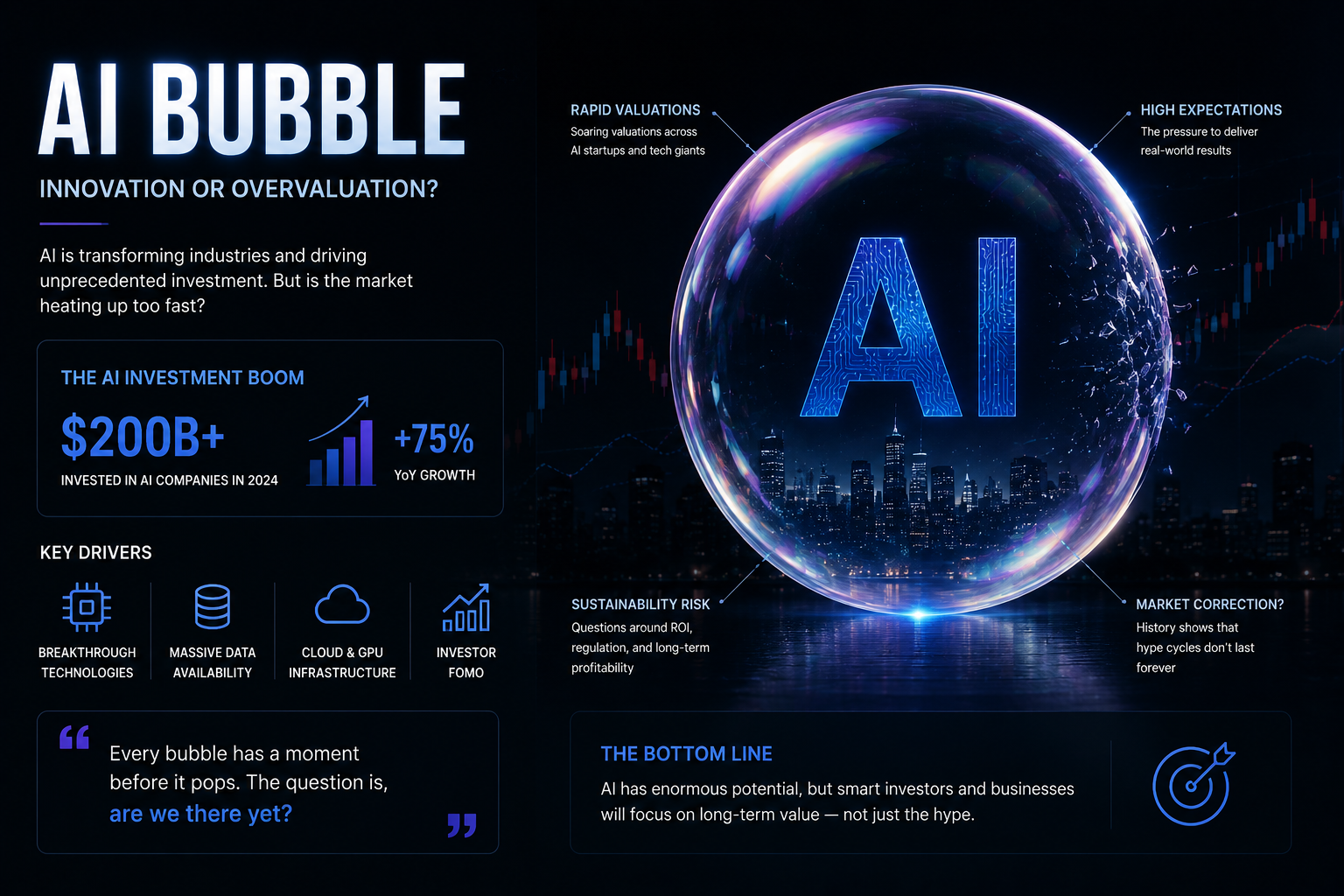
Artificial intelligence has moved from a specialist technology to a major force in business, finance, software, and everyday life. Companies are investing billions in AI models, data centers, chips, cloud computing, and AI-powered products.
That explosive growth has also created an important question: Are we in an AI bubble?
The concern isn’t simply that artificial intelligence is overhyped. AI is already producing measurable economic value. Stanford’s 2026 AI Index reports that global corporate AI investment more than doubled in 2025, while organizational AI adoption reached 88%. Generative AI also reached 53% population-level adoption within three years.
At the same time, some investors and economists believe parts of the market may be pricing in unrealistic future growth.
Understanding the AI bubble debate requires looking beyond headlines and examining investment, valuations, revenue, infrastructure spending, adoption, and the risks facing the industry.
What Is an AI Bubble?
An AI bubble occurs when enthusiasm and financial expectations surrounding artificial intelligence push company valuations or investment levels beyond what underlying business fundamentals can reasonably support.
In simple terms, a bubble can develop when people buy or invest because they expect prices to keep rising rather than because current earnings and cash flows justify those prices.
The term AI bubble does not mean artificial intelligence itself is worthless. A technology can be genuinely transformative while parts of its investment market become overheated.
This distinction is important. The current AI economy includes profitable businesses, useful products, infrastructure demand, speculative startups, and highly valued companies. These shouldn’t all be treated as the same thing.
Why Are People Talking About an AI Bubble?
The AI bubble debate has grown because several trends are happening at the same time.
Massive AI Investment
Investment has reached extraordinary levels. Stanford’s 2026 AI Index found that global corporate AI investment more than doubled during 2025. Private investment increased particularly quickly, while generative AI funding grew by more than 200%.
U.S. private AI investment alone reached approximately $285.9 billion in 2025, according to Stanford’s report.
High Expectations
Investors aren’t only valuing AI companies according to what they earn today. Many valuations depend on expectations about future AI demand, productivity improvements, software sales, and automation.
That creates risk if future growth doesn’t arrive as quickly as expected.
Huge Infrastructure Spending
AI requires enormous computing resources. Companies are spending heavily on GPUs, servers, networking equipment, electricity, and data centers.
Stanford reports that major cloud providers have accelerated capital expenditures, with Google reporting more than $150 billion in annual capital expenditure in 2025.
The question is whether future AI revenue will generate enough returns to justify that infrastructure spending.
How the AI Investment Boom Developed
The modern AI investment cycle accelerated after generative AI became widely accessible.
ChatGPT’s public launch in late 2022 demonstrated that AI could produce useful text and interact with people in a simple interface. Businesses quickly began exploring AI for customer service, software development, marketing, research, data analysis, and automation.
Investment followed.
By 2024, global private investment in generative AI had reached $33.9 billion, according to Stanford’s 2025 AI Index.
The market then expanded beyond chatbots. Investors began focusing on AI agents, enterprise software, robotics, specialized models, semiconductor companies, and data-center infrastructure.
This broader ecosystem is one reason the AI bubble question is difficult to answer with a simple yes or no.
Signs That Could Point to an AI Bubble
Several characteristics of the current market deserve careful attention.
1. Valuations Can Depend on Future Growth
Some AI-related companies are valued based heavily on expectations of enormous future markets.
That isn’t automatically irrational. Young technology companies often need years to mature. However, the greater the expectations, the greater the disappointment if growth slows.
2. Rapid Capital Expenditure
AI infrastructure requires enormous upfront spending.
If companies build computing capacity faster than customers ultimately need it, utilization and investment returns could fall.
3. Speculative Investor Behavior
Sharp increases in AI-related assets can attract investors who don’t fully understand the underlying businesses.
Recent market events illustrate how quickly enthusiasm can reverse. For example, Chinese robotics company Unitree experienced a dramatic rise after its stock-market debut before losing roughly 45% of its value, renewing concerns about speculative technology valuations.
One company doesn’t prove that the entire AI market is a bubble, but such episodes demonstrate how quickly enthusiasm can become volatility.
4. Uncertain Returns on AI Spending
Companies are still trying to determine how much revenue and productivity improvement they can generate from enormous AI investments.
INSEAD researchers identified rising capital expenditure, high valuations, and complex financial relationships among major AI companies as reasons behind current bubble concerns.
Reasons the AI Boom May Be Different
Calling the entire AI industry a bubble would overlook important evidence.
AI Is Already Being Used at Scale
AI isn’t merely a concept for the future.
Stanford’s 2026 AI Index found that 88% of surveyed organizations were using AI in at least one business function in 2025. Generative AI was used in at least one business function by 70% of organizations.
That is very different from investing in a technology with almost no real-world adoption.
Consumers Are Receiving Measurable Value
Generative AI tools are also delivering value to consumers.
Stanford estimates that the annual consumer surplus from generative AI in the United States reached $172 billion by early 2026, up substantially from the previous year.
This suggests that at least some of the demand for AI isn’t based purely on speculation.
AI Could Improve Productivity
AI can help employees complete certain tasks faster, automate repetitive work, support decision-making, and improve access to information.
That means even if some AI companies become overvalued, the technology itself can continue generating economic benefits.
Economists have also argued that an investment boom can leave behind productive infrastructure even if valuations later decline. A 2026 NBER working paper describes this possibility as a scenario in which optimistic investment creates lasting productive capacity even after valuations correct.
What Could Cause an AI Bubble to Burst?
A bubble could deflate if expectations become disconnected from financial reality.
Several developments could trigger a major correction:
- AI revenue growth slows significantly.
- Companies reduce AI capital expenditure.
- AI infrastructure becomes oversupplied.
- Investors demand faster returns.
- Interest rates increase financing costs.
- AI products fail to achieve expected productivity gains.
- Competition causes AI prices to fall sharply.
- Regulation increases operating costs or limits certain applications.
A correction wouldn’t necessarily mean AI disappears. It could simply mean investors begin assigning more realistic prices to companies and projects.
AI Bubble vs. Dot-Com Bubble
The dot-com boom of the late 1990s provides a useful comparison.
Both periods involve:
- Rapid technological innovation
- Strong investor enthusiasm
- Large amounts of capital
- New companies entering the market
- Expectations of major economic transformation
However, there is a major difference.
Many dot-com businesses had limited revenue or viable business models. Today’s AI ecosystem includes established technology companies, paying enterprise customers, cloud infrastructure, semiconductor sales, and widespread consumer adoption.
Stanford’s research shows that AI adoption and investment have moved well beyond the experimental stage.
That doesn’t eliminate the possibility of an AI market correction. It simply means today’s situation isn’t a perfect repeat of the dot-com era.
What an AI Correction Could Mean
If an AI bubble partially bursts, the impact could vary across the industry.
AI Startups
Startups without strong revenue, clear differentiation, or sustainable costs could struggle to raise additional funding.
Technology Stocks
AI-exposed stocks could experience significant volatility if investors lower their expectations for future earnings.
AI Infrastructure
Data-center, semiconductor, and networking companies could face slower growth if customers reduce capital spending.
Businesses Using AI
A market correction wouldn’t necessarily make AI less useful. Companies could continue using AI to reduce costs, improve productivity, and create new products.
In fact, a downturn could push businesses to focus more heavily on practical applications instead of experimental projects.
How Businesses and Investors Can Respond
Whether you’re running a company or evaluating AI investments, focusing on fundamentals is more useful than trying to predict the exact moment a bubble might burst.
Consider these questions:
- Does the AI product solve a genuine problem?
- Is there evidence that customers will pay for it?
- Can the business generate sustainable margins?
- How dependent is it on outside funding?
- Are infrastructure costs reasonable?
- Does technology provide a meaningful advantage?
- Can the company continue growing if AI enthusiasm declines?
For businesses, the safest approach is usually to measure AI projects against clear outcomes such as revenue, productivity, customer satisfaction, or reduced operating costs.
For investors, diversification and careful analysis remain more reliable than assuming every AI-related company will become a long-term winner.
Key Takeaways
- The AI bubble debate concerns valuations, investment, and expectations around artificial intelligence.
- AI investment has grown exceptionally quickly, with global corporate investment more than doubling in 2025.
- AI adoption is already widespread, which separates the current boom from purely speculative technology cycles.
- High valuations and enormous infrastructure spending still create financial risks.
- A correction in AI stocks would not mean artificial intelligence has failed.
- The strongest AI businesses are likely to be those with sustainable revenue, useful products, and measurable customer value.
- The AI market may contain both genuine technological progress and areas of excessive speculation at the same time.
FAQs
1. What is an AI bubble?
An AI bubble is a situation in which investment, valuations, or expectations surrounding artificial intelligence become significantly higher than the underlying economic results can justify.
2. Is AI currently in a bubble?
There are clear signs of unusually high investment and optimistic expectations, but there is no simple consensus that the entire AI industry is a bubble. AI adoption, revenue, and consumer value are also growing rapidly.
3. Could the AI bubble burst?
Yes. If AI revenue, productivity gains, or demand fail to meet expectations, valuations could fall sharply. However, a market correction would not necessarily stop the development or use of AI.
4. Is the AI bubble similar to the dot-com bubble?
There are similarities, including technological excitement and aggressive investment. However, today’s AI industry has much stronger evidence of real adoption, commercial demand, and infrastructure use than many early internet companies had during the dot-com boom.
5. What happens if the AI bubble bursts?
AI-related stocks and startups could lose value, venture funding could decline, and companies could reduce infrastructure spending. At the same time, useful AI products and profitable businesses could continue operating.
6. Why are companies spending so much money on AI?
Businesses are investing in AI because they expect it to improve productivity, automate tasks, create new products, and strengthen their competitive position. Stanford’s research shows that organizational AI adoption has reached historically high levels.
7. Does an AI bubble mean artificial intelligence is overhyped?
Not necessarily. A technology can be genuinely valuable while some companies or investments associated with it become overvalued. The important distinction is between the technology’s real economic potential and the price investors are willing to pay for that potential.
Conclusion
The AI bubble debate is unlikely to disappear soon because artificial intelligence combines genuine technological progress with extraordinary financial expectations.
There are legitimate reasons for caution. AI investment is growing at remarkable speed, infrastructure spending is enormous, and some valuations depend on very strong assumptions about future growth.
But the evidence also shows that AI isn’t simply a speculative idea. Businesses and consumers are already using AI at scale, and measurable economic value is emerging.
The more useful question, therefore, may not be whether AI itself is a bubble. It is whether individual companies, investments, and infrastructure projects are priced realistically.
If the market eventually corrects, the strongest AI technologies and businesses may survive while weaker or overly speculative projects disappear. That would be less a failure of artificial intelligence and more a normal process of separating long-term value from short-term enthusiasm.
Learn About: Google Gemini AI
