

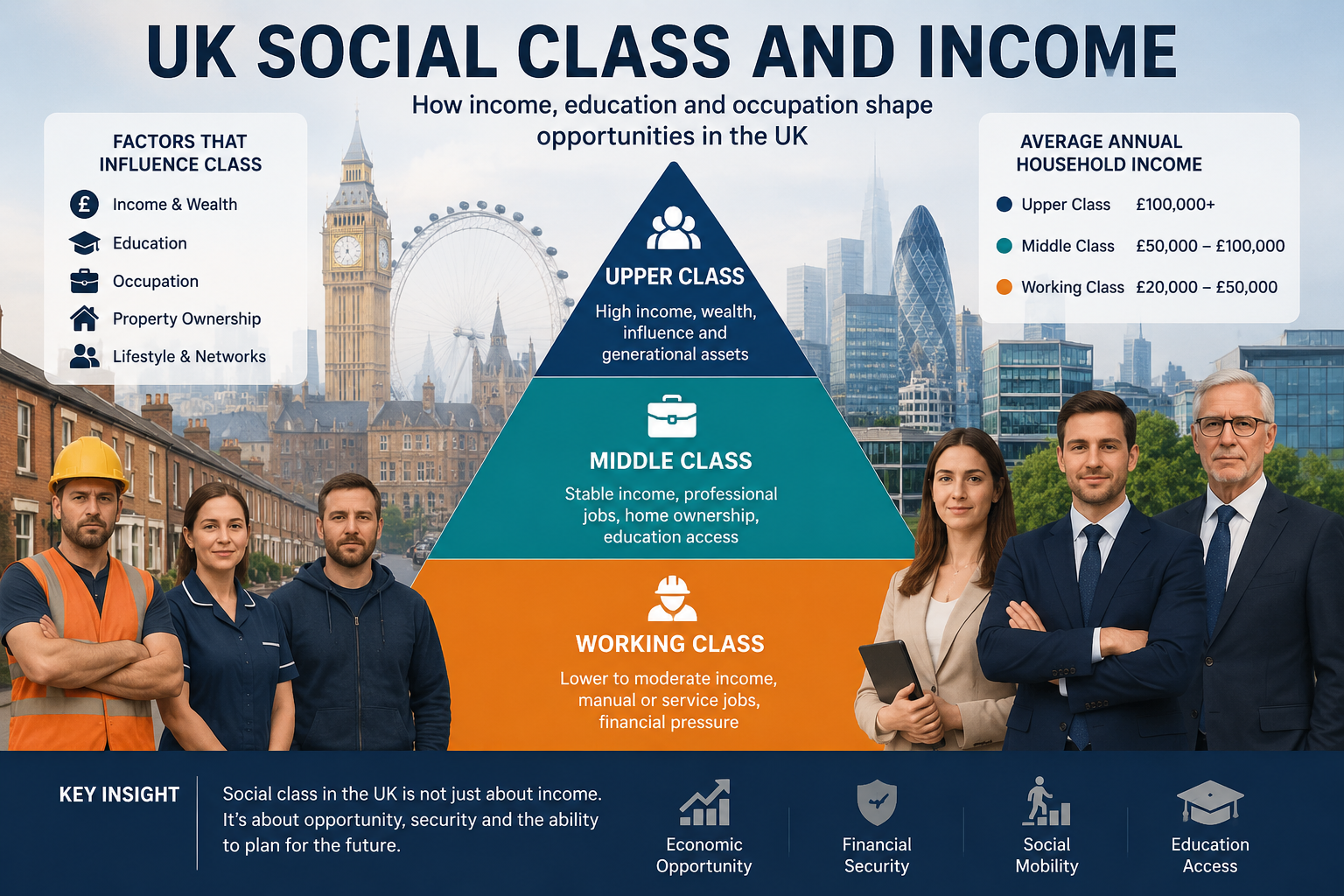
The relationship between social class and income in the UK is more complicated than simply dividing people into rich and poor. A person’s occupation, education, housing situation, family background, savings and access to opportunities can all influence where they sit within Britain’s social structure.
Income remains one of the clearest ways to understand economic differences. However, two people earning similar salaries may have very different levels of wealth or financial security. Someone who owns a valuable home, for example, may be in a stronger financial position than another person with the same income who rents.
Understanding UK social class and income therefore requires looking at both earnings and the wider circumstances that shape people’s lives.
What Is Social Class in the UK?
Social class describes broad groups of people who share similar economic, social or occupational circumstances. Traditionally, Britain has been associated with a class system involving the working class, middle class and upper class.
Modern social class is less straightforward.
Today, researchers may consider several factors, including:
- Type of occupation
- Employment status
- Household income
- Educational background
- Home ownership
- Wealth and savings
- Social and professional networks
- Family background
- Lifestyle and cultural factors
This means a person’s class identity cannot always be determined by their salary alone.
For a wider explanation of social class and socioeconomic differences, readers can also explore social class and socioeconomics, which provides useful context on how economic position and social circumstances interact.
How Income Relates to Social Class
Income is the money an individual or household receives over a particular period. It may come from employment, self-employment, investments, pensions or government benefits.
Social class, on the other hand, is a broader concept.
A professional earning £60,000 a year might be considered middle class, but their financial situation could be very different depending on where they live and whether they own property. A household earning the same amount in an expensive area may have less disposable income than a household with lower housing costs elsewhere.
Income can therefore influence social class, but it does not define it by itself.
Gross Income vs Disposable Income
It is also important to distinguish between gross and disposable income.
Gross income is the amount received before deductions such as income tax and National Insurance.
Disposable income is what remains after taxes and other essential deductions. This is often more useful when considering a household’s actual spending power.
For example, two households with identical gross salaries may have different disposable incomes because of differences in tax, childcare, housing or other costs.
Main Social Classes in the UK
There is no single official system that places every person in one fixed social class. However, several broad categories are commonly used when discussing British society.
Working Class
The working class has traditionally been associated with manual and routine occupations. Today, the group can include people working in manufacturing, construction, transport, retail, hospitality and various service-sector roles.
Working-class households can have very different income levels, so the term should not automatically be treated as a synonym for low income.
Middle Class
The middle class is often associated with professional, managerial and skilled occupations.
Examples may include:
- Teachers
- Accountants
- Engineers
- Managers
- Healthcare professionals
- Business owners
- Office-based professionals
Again, income varies significantly within this group.
Upper Class
The upper class has traditionally been linked to inherited wealth, influential families, major property ownership and high social status.
In modern Britain, substantial wealth can also come from successful businesses, investments and high-value assets rather than inheritance alone.
Income Differences Between Social Groups
Income inequality is an important part of understanding the UK’s class structure. People in higher-paid occupations generally have greater earning potential, while workers in lower-paid sectors may have less financial flexibility.
Several factors can influence earnings:
| Factor | Possible Effect on Income |
| Education | Can improve access to higher-paid occupations |
| Occupation | Some professions have significantly higher salaries |
| Experience | Earnings often increase with career progression |
| Location | Pay and living costs vary across regions |
| Industry | Certain industries offer stronger earning potential |
| Working hours | More hours can increase total earnings |
| Employment type | Permanent, temporary and self-employed workers may have different income patterns |
The relationship is not automatic. Highly educated people can work in modestly paid professions, while some people without university degrees can earn substantial incomes through skilled trades, business ownership or other careers.
Wealth and Social Class
Income tells only part of the story.
Wealth includes assets such as property, savings, investments and business ownership, minus debts. This distinction is particularly important in the UK because property ownership can have a major effect on long-term financial security.
Someone may have a moderate annual salary but own a mortgage-free home worth a substantial amount. Another person may earn more each year but have little savings and significant housing costs.
This is why income inequality and wealth inequality should be considered separately.
Why Wealth Can Last Across Generations
Wealth can also be passed between generations through property, savings, investments and inheritance.
A family with substantial assets may be able to help younger relatives with:
- University expenses
- Housing deposits
- Business investment
- Education
- Emergency costs
These advantages can influence opportunities even when two people have similar employment incomes.
Education, Occupation and Social Mobility
Education is another major factor in discussions about social class.
Higher levels of education can provide access to professions that require specialist qualifications. However, educational achievement is also influenced by family circumstances, school quality, financial resources and social networks.
Social mobility refers to movement between social or economic positions.
A person may experience upward mobility by entering a higher-paying profession than their parents. Conversely, economic difficulties, unemployment or changes in the labour market can contribute to downward mobility.
Is Social Mobility Easy in the UK?
Social mobility can happen, but opportunities are not evenly distributed.
Factors such as family wealth, location, education and access to professional networks can affect how easily someone can progress economically.
This is one reason class remains an important subject in discussions about opportunity and inequality.
Regional Differences in Income
Where someone lives can make a significant difference to both income and living standards.
London and parts of southeast England tend to have higher wages in many professional sectors. However, these areas also have some of the UK’s highest housing and living costs.
Other regions may have lower average salaries but cheaper housing and everyday expenses.
This creates an important distinction between income and purchasing power.
For example, a salary that appears modest in London may provide a different standard of living in a smaller city or town where rent and property prices are lower.
Has the UK Class System Changed?
The traditional image of Britain as a society divided into a small upper class, a large middle class and a working class has changed considerably.
The growth of service industries, technology, professional occupations and flexible employment has created a more diverse labour market.
People may also identify with more than one aspect of class. Someone may have a professional career while coming from a working-class family. Another person may have significant wealth but earn a relatively modest salary.
Class identity can therefore involve both present circumstances and personal background.
Why Social Class Still Matters
Social class can affect everyday experiences in ways that are not immediately visible.
It can influence:
- Employment opportunities
- Educational choices
- Housing options
- Access to professional networks
- Financial resilience
- Health and wellbeing
- Career progression
- Children’s future opportunities
Income is especially important during periods of rising living costs. Households with limited disposable income may have less ability to absorb unexpected expenses, while wealthier households can often rely on savings or assets.
The topic also matters for businesses and policymakers. Understanding differences in income and economic circumstances can help organisations design services, employment policies and financial products that better reflect the needs of different groups.
For readers interested in broader economic and business trends beyond the UK, South Africa business and technology offers another perspective on how economic development, business activity and technology can shape modern societies.
Key Takeaways
- Social class and income are related but are not identical.
- Income measures money received, while class includes broader social and economic factors.
- Occupation, education, wealth and housing can all influence social position.
- Wealth can provide advantages that are not reflected in annual income.
- Regional differences affect both salaries and living costs.
- Social mobility allows people to move between economic and social positions, but opportunities are not equally distributed.
- The UK’s traditional class structure has changed, but class remains relevant.
FAQs
What is the relationship between social class and income in the UK?
Income is one factor linked to social class, but occupation, education, wealth and background also matter.
Is social class based only on income?
No. Social class also depends on factors such as occupation, education, wealth and lifestyle.
What is considered middle class in the UK?
There is no official income limit. The middle class is often linked to professional and managerial jobs, but incomes can vary.
Does home ownership affect social class?
Home ownership can improve financial security and wealth, but it does not automatically determine social class.
Why is wealth different from income?
Income is money earned over time, while wealth includes assets such as property, savings and investments.
Can someone move from one social class to another?
Yes. Education, career growth and changes in wealth can support social mobility.
Conclusion
The relationship between UK social class and income is shaped by far more than earnings alone. While income plays an important role in determining financial security and opportunities, factors such as occupation, education, wealth, housing and family background also influence a person’s social position.
Although the UK’s class structure has evolved over the years, significant economic differences continue to affect people’s living standards, opportunities and long-term financial security. Examining both income and wealth therefore offers a broader and more accurate view of social class in modern British society.
