

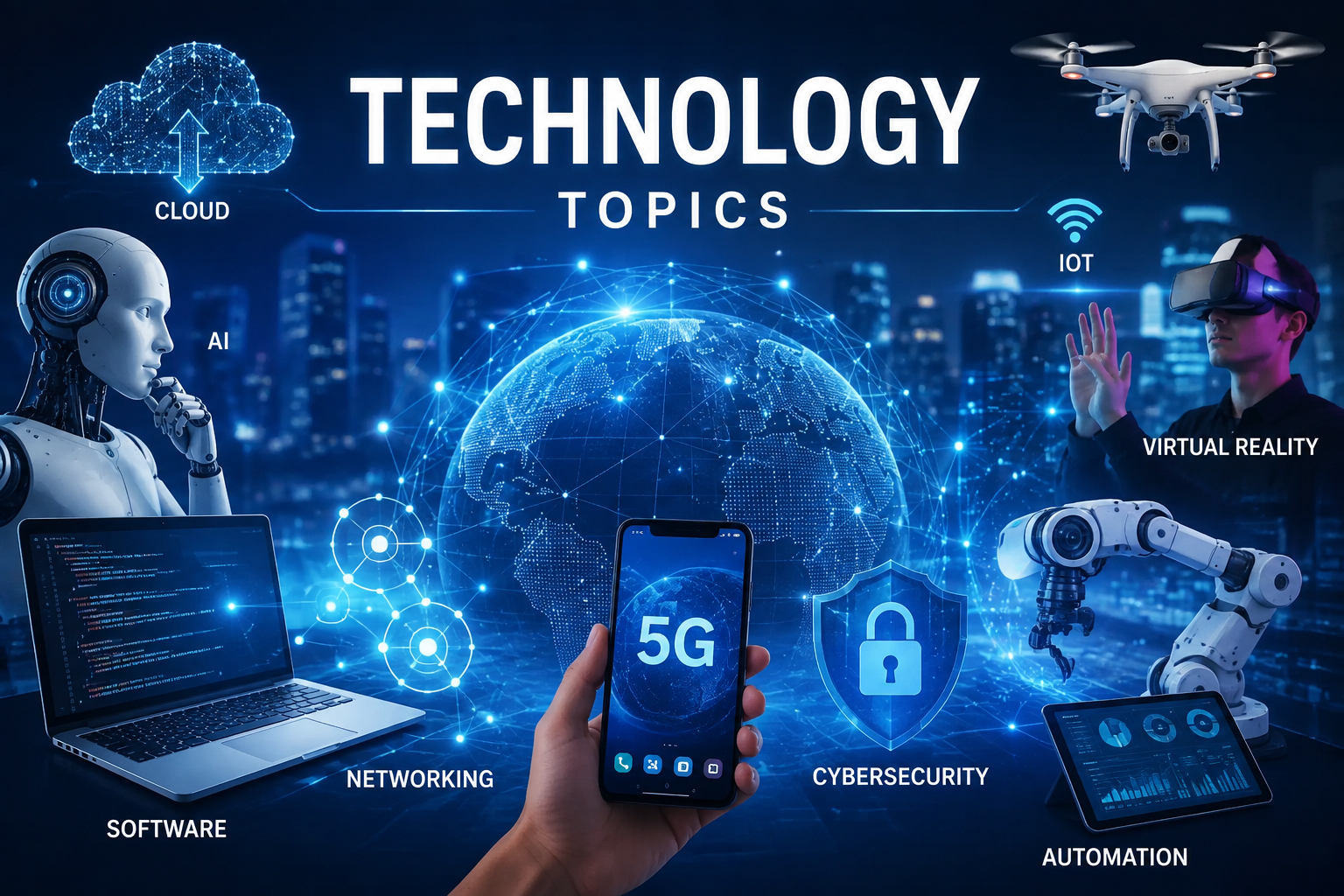
Technology is no longer limited to computers and smartphones. It now influences almost every part of everyday life, from the way businesses communicate with customers to how hospitals manage information and how developers build digital products.
For students, professionals, entrepreneurs, researchers, and technology enthusiasts, understanding the right technology topics can make it easier to keep up with a rapidly changing digital world.
Technology also moves quickly. A tool that seems revolutionary today can become outdated within a few years. That makes it useful to focus not only on individual products but also on the broader technologies and ideas shaping the industry.
This guide explores the most important technology topics, why they matter, and where they are being used.
What Are Technology Topics?
Technology topics are broad subjects related to digital systems, computing, engineering, software, hardware, data, automation, and emerging innovations.
They can range from basic subjects such as computer networks and mobile applications to advanced fields such as artificial intelligence, quantum computing, and autonomous systems.
Some technology topics focus on how systems work, while others examine how technology affects businesses, society, education, healthcare, and the economy.
Why Technology Topics Matter
Keeping up with technology topics has practical value because technology influences both personal and professional decisions.
Understanding current technology can help you:
- Identify useful digital tools.
- Develop valuable career skills.
- Understand cybersecurity risks.
- Make better technology purchasing decisions.
- Follow important industry developments.
- Discover new business opportunities.
- Understand how automation affects different jobs.
- Communicate more effectively with technical teams.
For businesses, technology knowledge can also support better decisions about software, infrastructure, data management, and digital transformation. Those interested in the financial side of the technology industry can also explore resources such as the Legal and General Global Technology Index to learn more about technology-focused market activity.
Top Technology Topics to Explore
1. Artificial Intelligence
Artificial intelligence (AI) is one of the most discussed technology topics today. AI systems can analyze information, recognize patterns, generate content, support decision-making, and automate certain tasks.
Generative AI has expanded the conversation even further by allowing systems to create text, images, audio, code, and other types of content.
Common applications include:
- Customer service chatbots
- Content generation
- Software development
- Fraud detection
- Recommendation systems
- Data analysis
- Business automation
The important issue isn’t simply whether AI can perform a task. Organizations also need to consider accuracy, privacy, security, transparency, and responsible use.
2. Cybersecurity
As more personal and business information moves online, cybersecurity remains essential.
Cybersecurity focuses on protecting devices, networks, applications, and data from unauthorized access, disruption, and other digital threats.
Important cybersecurity areas include:
- Password security
- Multi-factor authentication
- Network protection
- Cloud security
- Malware prevention
- Data privacy
- Identity management
- Security awareness
Cybersecurity isn’t only a concern for large corporations. Small businesses and individuals also need basic security practices to reduce unnecessary risks.
3. Cloud Computing
Cloud computing allows organizations and individuals to access computing resources over the internet instead of relying entirely on local infrastructure.
Cloud services can provide computing power, storage, databases, networking, and software applications.
Popular cloud models include:
| Model | Main Purpose |
| IaaS | Provides computing infrastructure |
| PaaS | Supports application development |
| SaaS | Delivers software through the internet |
Cloud computing has become important because it can offer scalability, remote access, and flexible resource management.
4. Software Development
Software development remains a foundational technology topic because almost every digital service depends on software.
Developers work with programming languages, frameworks, databases, APIs, testing systems, and development platforms to create applications and digital products.
Modern software development increasingly involves automation, collaborative development environments, cloud infrastructure, and AI-assisted coding tools.
For anyone starting a technology career, learning programming fundamentals can provide a strong foundation.
5. Internet of Things (IoT)
The Internet of Things refers to physical devices that connect to networks and exchange data.
Examples include:
- Smart home devices
- Wearable fitness technology
- Connected vehicles
- Industrial sensors
- Smart appliances
- Agricultural monitoring systems
IoT can help organizations monitor equipment and collect information in real time. However, connected devices also introduce security and privacy considerations.
6. Robotics and Automation
Robotics combines software, mechanical engineering, sensors, and control systems to create machines capable of performing physical tasks.
Automation is particularly valuable in manufacturing, logistics, healthcare, agriculture, and other industries.
Robots can perform repetitive or hazardous tasks, while automated software can handle routine digital processes.
The future of automation is likely to involve greater collaboration between humans, software systems, and physical machines.
7. Data Science and Analytics
Organizations generate huge amounts of information every day. Data science helps turn that information into useful insights.
Data professionals may work with:
- Statistics
- Databases
- Machine learning
- Data visualization
- Predictive modeling
- Business intelligence
For example, a retailer can analyze purchasing patterns to understand customer demand, while a manufacturer can use sensor data to identify equipment problems.
8. Blockchain Technology
Blockchain is a type of distributed ledger technology designed to record information across a network.
Although blockchain became widely associated with cryptocurrencies, its potential applications extend beyond digital currencies.
Possible applications include:
- Supply-chain tracking
- Digital identity
- Asset records
- Smart contracts
- Transaction verification
The usefulness of blockchain depends heavily on the specific problem being solved. Not every digital record requires a blockchain.
9. Quantum Computing
Quantum computing is an emerging field that uses principles of quantum mechanics to process information in fundamentally different ways from conventional computers.
Researchers are investigating potential applications in areas such as:
- Materials science
- Chemistry
- Optimization
- Cryptography
- Scientific simulation
Quantum computing is still developing, so many practical applications remain an active area of research.
10. Extended Reality
Extended reality includes technologies such as virtual reality (VR), augmented reality (AR), and mixed reality (MR).
These technologies can create or enhance digital experiences.
Businesses and educational institutions are exploring applications in:
- Training
- Product demonstrations
- Education
- Gaming
- Design
- Remote collaboration
As hardware improves, immersive technologies may become more useful for specialized professional applications.
11. Edge Computing
Edge computing moves certain data processing closer to where the data is generated.
Instead of sending every piece of information to a distant data center, some processing can happen locally on or near the device.
This can be useful when systems require quick responses, reduced network traffic, or more localized data processing.
Applications include connected vehicles, industrial systems, smart cities, and IoT networks.
12. Digital Privacy
Digital privacy has become an increasingly important technology topic as organizations collect and process large quantities of personal information.
Privacy involves questions such as:
- What data is being collected?
- Why is it being collected?
- Who can access it?
- How long is it retained?
- How is it protected?
Consumers should understand the permissions they grant to applications and the information they share online.
13. Developer Tools and Productivity Technology
Developers now have access to a growing range of tools designed to simplify coding, testing, debugging, project management, and deployment.
Modern developer tools may include code editors, version-control platforms, API testing solutions, automation services, and AI-assisted development platforms.
For people interested specifically in this area, resources covering tech tools for developers can provide ideas for exploring the growing developer-tool ecosystem.
The best tool depends on the developer’s language, project requirements, workflow, and team environment.
How Technology Is Changing Different Industries
Technology doesn’t operate separately from the real world. It is changing how many industries operate.
| Industry | Examples of Technology Use |
| Healthcare | Telemedicine, electronic records, AI-assisted analysis |
| Finance | Digital banking, fraud detection, automation |
| Education | Online learning, digital classrooms, adaptive tools |
| Retail | E-commerce, recommendation systems, inventory technology |
| Manufacturing | Robotics, sensors, predictive maintenance |
| Transportation | Navigation, connected vehicles, automation |
| Agriculture | Smart irrigation, sensors, data-driven farming |
| Media | Streaming, digital publishing, content technology |
The impact differs from one industry to another. Some sectors prioritize automation, while others focus more heavily on data, security, or communication.
How to Choose a Technology Topic
If you’re selecting a topic for research, a blog post, presentation, or academic project, start with your purpose.
For Beginners
Choose accessible subjects such as:
- How cloud computing works
- Basics of cybersecurity
- Introduction to artificial intelligence
- How websites work
- What is IoT?
For Students
More focused subjects may include:
- AI in education
- Cybersecurity awareness
- Blockchain applications
- Data privacy
- Robotics in manufacturing
For Professionals
Consider practical areas such as:
- AI automation
- Cloud migration
- Data analytics
- Enterprise cybersecurity
- Developer productivity
- Digital transformation
A strong technology topic should be specific enough to research properly but broad enough to provide useful information.
Technology Topics for Students and Professionals
Technology is also a valuable area for career development. Instead of trying to learn everything, focus on skills connected to a specific career goal.
For example:
Interested in software? Learn programming, databases, APIs, version control, and software testing.
Interested in data? Study statistics, SQL, data visualization, and machine learning fundamentals.
Interested in security? Explore networks, authentication, security principles, and risk management.
Interested in AI? Start with programming and data fundamentals before moving into machine learning and generative AI.
This approach creates a stronger learning path than jumping between unrelated tools.
Key Takeaways
- Technology topics cover a wide range of digital and engineering subjects.
- AI, cybersecurity, cloud computing, software development, IoT, and data analytics remain major areas of interest.
- Robotics, quantum computing, blockchain, and extended reality represent important emerging fields.
- Technology affects nearly every major industry.
- The best topic depends on your goals, experience, and area of interest.
- Learning fundamental concepts is often more valuable than chasing every new tool.
- Privacy, security, responsible AI, and trustworthy technology should remain part of the conversation.
FAQs
1. What are the most important technology topics?
AI, cybersecurity, cloud computing, software development, data analytics, IoT, robotics, blockchain, and quantum computing are major technology topics.
2. What technology topic is best for beginners?
AI basics, cybersecurity, cloud computing, web development, and computer networking are good choices for beginners.
3. Why is artificial intelligence an important technology topic?
AI helps automate tasks, analyze data, generate content, and support decision-making across many industries.
4. Is cybersecurity a good technology topic to study?
Yes. Cybersecurity is important for protecting digital systems, networks, applications, and data.
5. What are emerging technology topics?
Emerging areas include quantum computing, advanced robotics, extended reality, edge computing, autonomous systems, and new applications of artificial intelligence.
6. How do I choose a technology topic for research?
Consider your audience, purpose, knowledge level, and available sources. A focused topic with a clear question is usually easier to research than an extremely broad subject.
7. Do technology topics only involve computers?
No. Technology also includes robotics, telecommunications, sensors, automation, biotechnology, transportation systems, manufacturing technology, and many other fields.
Conclusion
The world of technology is broad, fast-moving, and constantly evolving. From artificial intelligence and cybersecurity to cloud computing, robotics, data analytics, and quantum computing, today’s technology topics cover much more than traditional computers and software.
The most useful way to explore technology is to focus on concepts and real-world applications rather than simply following every new product or trend. Understanding how a technology works, what problem it solves, and what limitations it has can provide much more lasting value.
Whether you’re a student researching a project, a professional developing new skills, or simply someone who wants to understand the digital world better, choosing the right technology topic is a practical first step toward becoming more informed and future-ready.
