

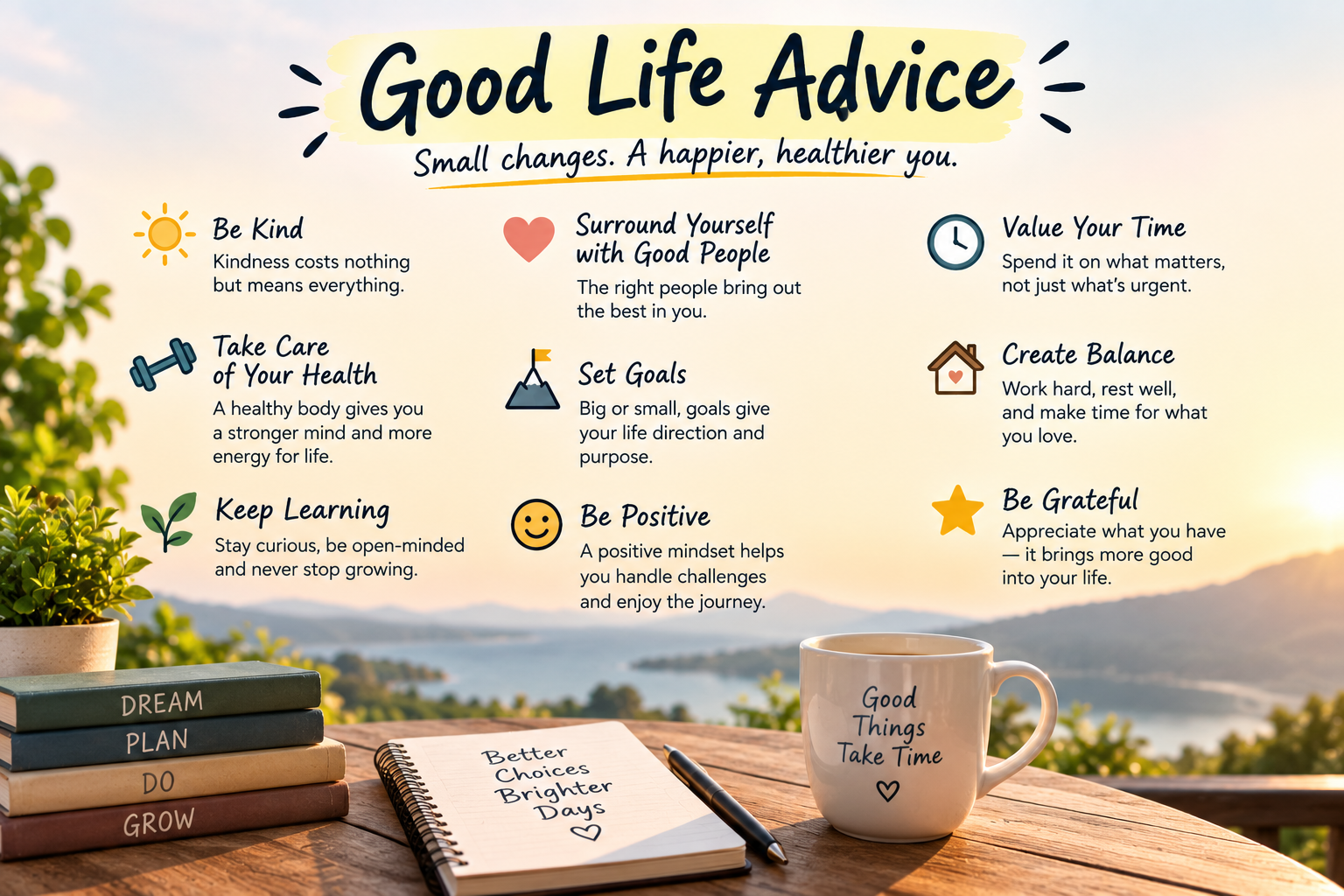
Good life advice is practical guidance that helps you make thoughtful choices, handle challenges, build meaningful relationships, protect your well-being, and create a life that reflects your values. It does not mean having a perfect life. Instead, it means learning from experience, focusing on what matters, and making small decisions that support long-term happiness and fulfillment.
What Does Good Life Advice Really Mean?
Life advice is often presented as a collection of simple rules, but real life is rarely that straightforward. What works for one person may not work for another because people have different responsibilities, priorities, personalities, and circumstances.
The most useful good life advice tends to share one quality: it encourages thoughtful choices rather than promising instant solutions. A fulfilling life is usually built through everyday decisions involving relationships, work, health, finances, personal boundaries, learning, and emotional well-being.
You do not need to change everything at once. In many cases, meaningful progress begins with small improvements that can be maintained over time.
Focus on What You Can Control
One of the most useful principles for everyday life is learning to distinguish between what you can control and what you cannot.
You can usually influence:
- How you respond to difficult situations
- How you spend your time
- The habits you develop
- The boundaries you establish
- The effort you put into your responsibilities
- The way you communicate with others
- Whether you learn from your experiences
You cannot completely control other people’s opinions, decisions, reactions, or behavior.
Constantly trying to control things outside your influence can create unnecessary frustration. Focusing your attention on your own choices can make difficult situations easier to manage and help you use your energy more productively.
Build Habits That Support Your Future
Good intentions are valuable, but consistent habits often have a greater effect on everyday life. Instead of depending entirely on motivation, create routines that make positive choices easier.
For example, you might:
- Set aside time for important tasks before less important ones.
- Keep a regular sleep schedule when possible.
- Make time for movement and physical activity.
- Read or learn something useful regularly.
- Plan major expenses rather than making decisions impulsively.
- Take short breaks when you have been working for long periods.
- Spend some time each day away from unnecessary digital distractions.
The goal is not to create a perfect routine. A sustainable routine that fits your actual life is generally more useful than an unrealistic schedule that becomes difficult to maintain.
Choose Your Relationships Carefully
The people around you can have a significant influence on your daily experience. Healthy relationships generally involve respect, honesty, communication, trust, and appropriate boundaries.
Good life advice is not simply to have as many relationships as possible. Instead, focus on developing connections where people can communicate openly, respect differences, and support one another.
It is also important to recognize that maintaining every relationship is not always necessary. If a relationship repeatedly creates conflict, disrespect, manipulation, or emotional exhaustion, establishing clearer boundaries may be appropriate.
At the same time, relationships require effort. Listening carefully, expressing appreciation, apologizing when you are wrong, and being present during difficult moments can strengthen meaningful connections.
Learn to Protect Your Time and Energy
Time is limited, and constantly saying yes can leave little room for the things that genuinely matter.
Learning to say no does not necessarily mean being selfish. It can mean understanding your priorities and recognizing your limits.
Before accepting a new commitment, consider:
- Does this genuinely matter to me?
- Do I have enough time for it?
- What will I have to give up to accommodate it?
- Am I agreeing because I want to or because I feel pressured?
- Does it support an important responsibility or goal?
You do not have to provide a lengthy explanation every time you decline something. A respectful and clear response can be enough.
Protecting your time also means reducing unnecessary distractions. Your attention is a resource, so use it intentionally.
Accept That Mistakes Are Part of Growth
Nobody makes consistently perfect decisions. Mistakes can happen in relationships, careers, education, finances, and everyday situations.
The useful response to a mistake is not to pretend it never happened or to remain trapped in regret. Instead, ask what the experience can teach you.
A simple reflection can help:
What happened? → What was within my control? → What did I learn? → What can I do differently next time?
This approach turns an uncomfortable experience into an opportunity for learning.
Taking responsibility is also important. Learning from mistakes does not mean blaming yourself for everything. It means recognizing your part honestly while considering the circumstances surrounding the situation.
Take Care of Your Physical and Emotional Well-Being
A meaningful life is difficult to enjoy when basic well-being is consistently neglected.
Physical and emotional health are connected to many areas of everyday life. Simple practices such as getting adequate rest, eating a balanced diet, staying physically active, maintaining social connections, and making time to recover from stress can support overall well-being.
Emotional care also matters. Give yourself space to acknowledge difficult feelings instead of automatically ignoring them.
When challenges become difficult to manage, reaching out to a trusted person or an appropriate professional can be a constructive step. Asking for support is not a failure; sometimes it is a practical way to deal with a situation responsibly.
Keep Learning and Stay Curious
Personal growth does not have to stop when formal education ends. Learning can come from books, conversations, practical experience, hobbies, mistakes, travel, work, and unfamiliar perspectives.
Staying curious can help you avoid becoming overly attached to assumptions. When you encounter an unfamiliar idea, consider asking:
- What can I learn from this?
- Is there evidence that challenges what I believe?
- Could there be another perspective?
- What would happen if I approached this differently?
You do not have to accept every new idea. Curiosity simply creates room to examine information before making a judgment.
Practice Gratitude Without Ignoring Reality
Gratitude can help people notice positive aspects of their lives, but it should not be used to dismiss genuine problems.
You can appreciate what is going well while still acknowledging what needs to change. For example, being grateful for supportive relationships does not mean accepting an unhealthy situation elsewhere. Appreciating your current achievements does not mean giving up on future goals.
A balanced approach allows gratitude and ambition to exist together.
Taking a few moments to recognize people, experiences, opportunities, or ordinary things you appreciate can shift attention toward what is meaningful without requiring you to ignore life’s difficulties.
Define Success for Yourself
Success is not identical for everyone.
For one person, success may involve professional achievement. For another, it may mean having more time with family, developing creative skills, building financial stability, contributing to a community, or maintaining a peaceful lifestyle.
Problems can arise when people measure their lives entirely through someone else’s definition of success.
Consider defining success according to your own values. Ask yourself:
- What kind of person do I want to become?
- What relationships matter most to me?
- What responsibilities do I want to handle well?
- What activities give my life meaning?
- What does a satisfying ordinary day look like?
These questions can provide more useful direction than constantly comparing your life with other people’s visible achievements.
Good Life Advice for Difficult Times
Difficult periods are unavoidable. During stressful circumstances, trying to solve everything simultaneously can make the situation feel even more overwhelming.
Start with the next manageable step.
If you are facing a complicated problem, separate it into smaller parts. Identify what requires immediate attention and what can wait. Talk to someone you trust when appropriate, gather reliable information, and avoid making major decisions purely from a moment of intense emotion when waiting is possible.
Remember that a difficult period does not necessarily define your entire life. Circumstances change, priorities evolve, and people can learn new ways of responding to challenges.
What is the best piece of good life advice?
Focus on what you can control and make decisions that reflect your values. Healthy relationships, responsible habits, and adaptability can help create a balanced life.
How can I improve my life one step at a time?
Choose one realistic area to improve instead of changing everything at once. Small, consistent improvements can gradually create meaningful long-term progress.
Why is setting boundaries important?
Boundaries help protect your time, energy, and personal priorities. They also make expectations clearer and can support healthier relationships.
How do I deal with mistakes in life?
Accept what happened, take responsibility for your part, and identify what you can learn from the experience. Use that lesson to make better decisions in the future.
Can money contribute to a good life?
Financial stability can provide flexibility and reduce some sources of stress. However, relationships, health, purpose, and personal fulfillment are also important parts of a good life.
How can I stop comparing myself with others?
Focus on your own goals, progress, values, and circumstances rather than constantly measuring yourself against others. Remember that people often show only part of their lives.
Is it necessary to have a clear purpose in life?
Not everyone needs one fixed purpose, and your priorities may change over time. Meaning can come from relationships, work, learning, creativity, service, and personal values.
What makes life meaningful?
Meaning can come from different sources depending on the individual. Strong relationships, personal values, contributing to others, learning, creativity, meaningful work, and experiences that matter to you can all contribute to a sense of purpose.
Conclusion
Good life advice is less about following a perfect set of rules and more about developing the judgment to make thoughtful decisions in changing circumstances. Focus on what you can control, invest in meaningful relationships, protect your time, care for your well-being, learn from mistakes, and define success according to your own values.
A fulfilling life does not require every day to be easy or every decision to be perfect. It is built gradually through the choices you make, the lessons you carry forward, and the things you decide are genuinely worth your time and attention.
Learn About: Lifestyle Healthcare
