

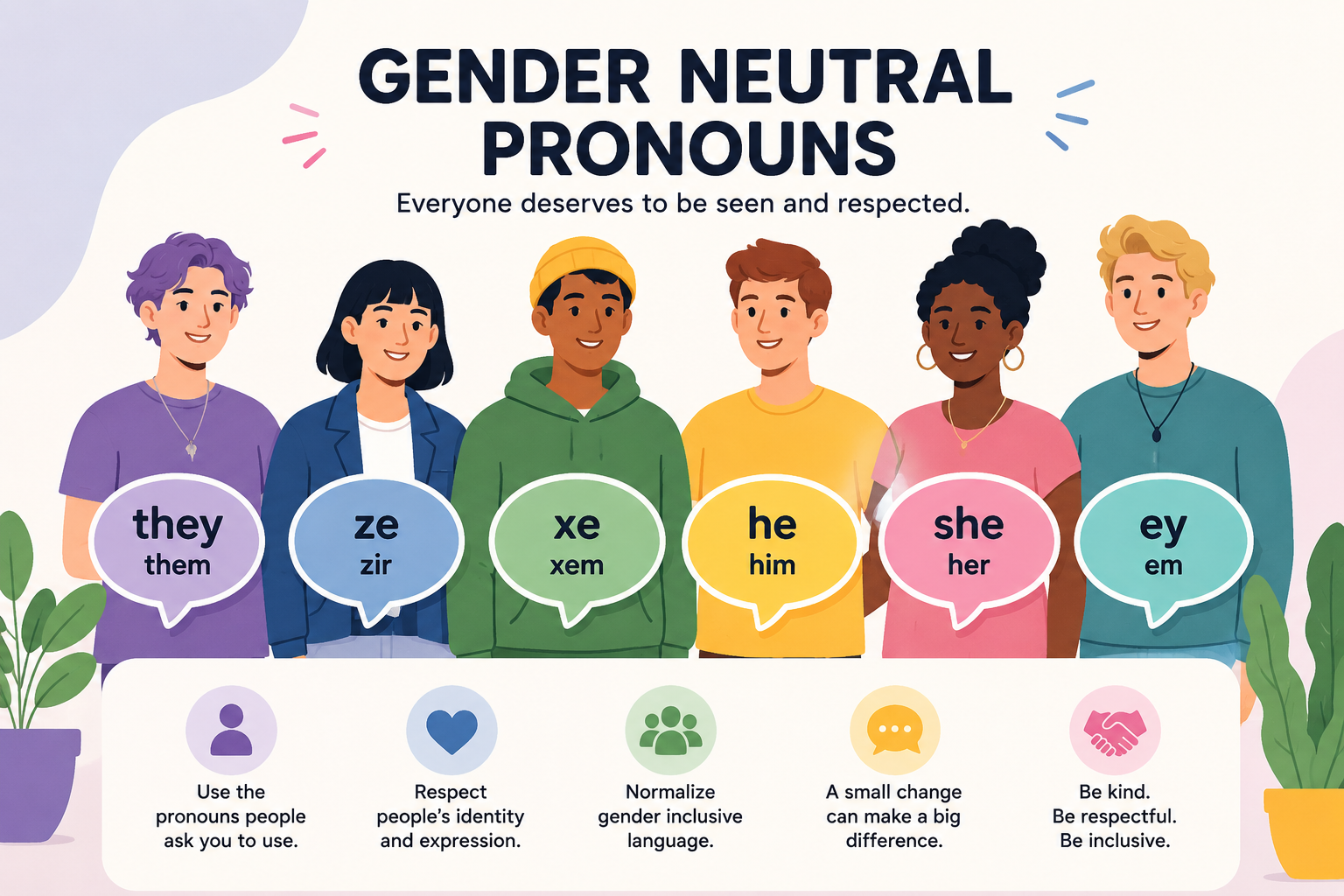
Language changes as the way people describe themselves changes. One area where this is especially noticeable is the use of pronouns. While English has traditionally used pronouns such as “he” and “she” to refer to people, not everyone identifies exclusively as a man or a woman.
That is where gender neutral pronouns come in.
These pronouns allow people to be described without assigning a specific gender. They can also be useful when a person’s gender is unknown, irrelevant to the conversation, or intentionally left unspecified.
Understanding how these pronouns work doesn’t require completely changing the way you speak. In most cases, it simply means becoming more aware of the words you choose and following the language a person uses for themselves.
What Are Gender Neutral Pronouns?
Gender neutral pronouns are words used to refer to a person without indicating that the person is specifically male or female.
The most widely used gender-neutral pronoun set in modern English is they/them/their. Importantly, “they” can be singular as well as plural.
For example:
- “Alex said they would arrive at six.”
- “I spoke with Jordan, and they sent me the information.”
- “Someone left their phone on the desk.”
- “The customer said they would return tomorrow.”
In each example, the person’s gender is either unknown, unspecified, or not relevant.
Gender-neutral language isn’t limited to pronouns. Words such as “person,” “individual,” “partner,” “parent,” and “child” can also be used when gender doesn’t need to be specified.
Common Gender Neutral Pronouns
There isn’t only one system of gender-neutral pronouns. Different people may use different sets, although they/them is by far the most familiar to English speakers.
| Pronoun Set | Example |
| They/Them | They brought their book with them. |
| Ze/Hir | Ze brought hir book with hir. |
| Ze/Zir | Ze brought zir book with zir. |
| Xe/Xem | Xe brought a xem book with xem. |
Some people may use one pronoun set exclusively, while others may use more than one. The best approach is not to assume. If pronouns are relevant, use the terms the individual has provided.
For readers unfamiliar with alternative pronouns, they/them is usually the easiest starting point because it is already a natural part of everyday English.
For example, if you don’t know who left a jacket behind, you might say, “Someone forgot their jacket.” No gender is assigned, and the sentence sounds completely natural.
When writing about real people, the same principle matters. Rather than guessing someone’s pronouns from their name, appearance, profession, or biography, writers should use the pronouns the person has publicly identified or the language provided by a reliable source. This is especially important when creating profiles or biographies, such as a story about a lifeguard and the responsibilities of the profession.
How Singular “They” Works
One of the most common questions about gender neutral pronouns is whether “they” can correctly refer to one person.
Yes. Singular “they” has a long history in English and is commonly used when a person’s gender is unknown, unspecified, or when the person uses they/them pronouns.
Consider this sentence:
“If a student has a question, they can speak with the teacher.”
The word “student” refers to one person in this sentence, but the person’s identity isn’t specified.
Another example is:
“Taylor said they would call later.”
Here, “they” refers to one specific person named Taylor.
Singular “they” is also useful when gender simply isn’t important to the meaning of a sentence. There’s no reason to write “he or she” every time an individual’s gender isn’t known.
Gender Neutral Pronouns Examples
Seeing gender neutral pronouns in complete sentences makes them easier to understand.
In Everyday Conversation
- “Someone is waiting outside. They said they have an appointment.”
- “Ask the manager if they can help.”
- “Your friend left their bag here.”
In Professional Writing
- “Every employee should submit their form before Friday.”
- “A customer can contact support if they need assistance.”
- “Each applicant should provide their contact information.”
When Referring to a Specific Person
If someone tells you that they use they/them pronouns, you can say:
- “Sam said they are available today.”
- “I met them after the meeting.”
- “That is their desk.”
The grammar may feel unfamiliar at first if you’ve mostly used “he” or “she,” but repeated use usually makes it much easier.
Why Pronouns Matter
Pronouns are small words, but they appear constantly in everyday communication. Using the correct pronouns helps people communicate accurately and can make conversations more comfortable and respectful.
Pronouns can also matter in workplaces, schools, healthcare settings, social groups, online communities, and personal relationships.
That doesn’t mean every conversation needs a discussion about gender. In many situations, the simplest approach is to use the pronouns someone has provided and move on.
The key idea is accuracy rather than overthinking.
If someone tells you they use they/them pronouns, using those pronouns is generally no more complicated than remembering their name.
How to Use Someone’s Pronouns Correctly
If you’re unsure about someone’s pronouns, there are several practical ways to handle the situation.
1. Listen to How They Describe Themselves
People may introduce themselves with their pronouns or include them in a profile, email signature, or social account.
2. Ask Politely When Appropriate
A simple question such as “What pronouns do you use?” can be enough.
There’s no need for a long explanation.
3. Practice Privately
If you’re learning a new pronoun set, practicing sentences in your head can help you become comfortable with it.
4. Don’t Make Assumptions
A person’s appearance, clothing, voice, name, or occupation doesn’t necessarily tell you which pronouns they use.
5. Correct Yourself and Continue
If you make a mistake, correct it briefly and continue the conversation.
What to Do If You Make a Mistake
Almost everyone can make a language mistake, especially when learning unfamiliar terminology.
Suppose you accidentally use the wrong pronoun. A simple correction is enough:
“Sorry, I meant they.”
You generally don’t need to turn the moment into a lengthy explanation or repeatedly apologize.
The goal is to use the correct pronouns going forward.
Overreacting can sometimes make an otherwise small mistake more uncomfortable. A quick correction followed by normal conversation is usually the most practical response.
Gender Neutral Pronouns in Everyday Communication
Gender-neutral language can be useful far beyond conversations about gender identity.
For example, imagine writing instructions for a job applicant. Instead of saying:
“When an applicant arrives, he or she should report to reception.”
You could write:
“When an applicant arrives, they should report to reception.”
The second version is shorter and avoids unnecessary gender assumptions.
This approach is particularly useful in:
- Workplace policies
- Customer service
- Educational materials
- Online forms
- News and editorial writing
- General instructions
- Public information
- Academic writing
It can make writing more inclusive without making it complicated.
Common Misunderstandings About Gender Neutral Pronouns
“They” Is Only Plural
This is one of the most common misconceptions. Singular “they” is established in English and is widely used in everyday speech and writing.
Gender Neutral Means Everyone Uses the Same Pronouns
Not necessarily. People have different preferences. They/them is common, but some individuals use other pronoun sets or combinations.
You Can Tell Someone’s Pronouns by Looking at Them
It’s better not to assume. Appearance doesn’t reliably communicate someone’s preferred pronouns.
Using Gender Neutral Language Means Avoiding “He” and “She”
Not at all. “He” and “she” remain appropriate when they accurately reflect how a person identifies and how they refer to themselves. Gender-neutral language is about having appropriate options rather than eliminating gendered pronouns.
Pronouns Are Only Relevant in Formal Situations
Pronouns appear in everyday conversation, text messages, emails, social media, classrooms, and family discussions. Using the right terms can therefore matter in almost any setting.
Gender Neutral Language When Writing About People
Writers have an additional responsibility because readers often rely on published content to understand another person.
When creating a profile, biography, news article, or personal story, avoid guessing someone’s gender based on their name or appearance. Use reliable information and, where available, the person’s own stated pronouns.
The same principle applies when describing people whose stories have received public attention. A person’s identity should not be reduced to assumptions made by the writer. Careful language can help keep biographical writing factual, respectful, and focused on the person rather than stereotypes.
For example, when exploring a biographical story about a teacher and the wider circumstances surrounding her life, readers can see how careful personal descriptions provide context beyond a headline. Read more about Sabina Nessa’s life and legacy
Key Takeaways
- Gender neutral pronouns refer to people without specifically identifying them as male or female.
- They/them is the most widely recognized gender-neutral pronoun set in English.
- Singular “they” can correctly refer to one person.
- Other pronoun sets, including ze/hir and ze/zir, are also used by some people.
- Don’t assume someone’s pronouns based on appearance, name, or profession.
- If someone tells you their pronouns, using them correctly is usually straightforward.
- If you make a mistake, correct yourself briefly and continue.
- Gender-neutral language can make professional, educational, and everyday writing more precise and inclusive.
FAQs
What are gender neutral pronouns?
Gender neutral pronouns are pronouns that don’t specifically identify a person as male or female. They/them is the most common example.
Is “they” a gender neutral pronoun?
Yes. “They” can be used as a singular gender-neutral pronoun as well as a plural pronoun.
Can I use they/them for one person?
Yes. Singular “they” is commonly used when referring to one person whose gender is unknown, unspecified, or who uses they/them pronouns.
What are some examples of gender neutral pronouns?
They/them/their is the most familiar set. Some people also use pronouns such as ze/hir, ze/zir, or xe/xem.
How do I know which pronouns someone uses?
If the person has stated their pronouns, use those. If you’re unsure and it matters to the conversation, asking politely is usually the simplest option.
What should I do if I use the wrong pronoun?
Briefly correct yourself and continue. You don’t need to make the conversation unnecessarily complicated.
Conclusion
Gender neutral pronouns are a practical part of modern English communication. They allow speakers and writers to refer to people without making assumptions about gender, while also providing language that accurately reflects how individuals describe themselves.
The most useful place to start is with they/them, especially because singular “they” already fits naturally into many everyday sentences. From there, understanding other pronoun sets and becoming comfortable asking when appropriate can make communication easier.
Ultimately, using pronouns respectfully is less about memorizing complicated rules and more about paying attention to the person you’re talking about. When language is accurate, thoughtful, and guided by the information a person provides about themselves, communication becomes clearer for everyone.
