

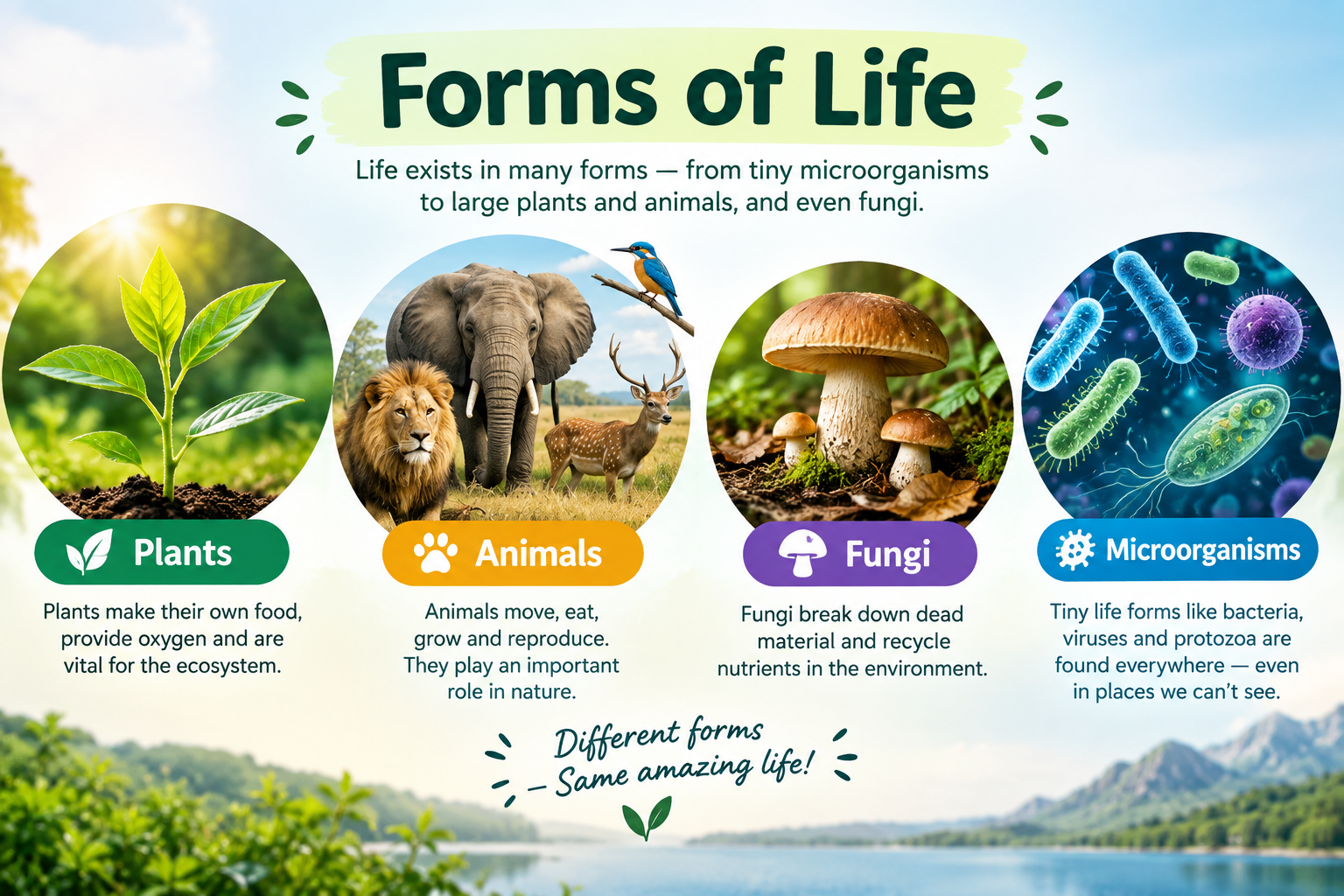
Forms of life refers to the wide variety of ways living organisms exist, grow, obtain energy, reproduce, adapt, and interact with their surroundings. From microscopic bacteria and single-celled organisms to plants, animals, fungi, and humans, life appears in many different structures and biological systems.
Every living organism has characteristics that allow it to function within its environment. Some organisms thrive in oceans, while others survive in deserts, forests, mountains, underground environments, or extremely cold and hot conditions. Studying forms of life helps us understand biodiversity, ecosystems, evolution, and the relationships between organisms and the natural world.
What Does “Forms of Life” Mean?
The term forms of life describes the enormous variety of living organisms found on Earth and the different ways they survive and function.
Although organisms can look and behave very differently, living things share several fundamental characteristics. They use energy, carry out biological processes, respond to their surroundings, and maintain some level of internal organization. Many organisms also grow, reproduce, and pass genetic information to the next generation.
The diversity of life means that these characteristics can appear in very different ways. A bacterium may consist of a single cell, while a large tree contains many specialized cells organized into tissues and structures.
Forms of life can therefore be studied from several perspectives, including cellular organization, nutrition, habitat, reproduction, behavior, and evolutionary relationships.
Key Characteristics of Living Organisms
Despite the enormous variety of life on Earth, living organisms generally share several important characteristics.
Cellular Organization
Cells are the basic structural and functional units of living organisms. Some organisms consist of only one cell, while others contain many cells that perform specialized functions.
Metabolism
Living organisms require energy and materials to maintain biological processes. The collection of chemical reactions that occur within an organism is known as metabolism.
Growth and Development
Many organisms change throughout their life cycles. These changes can include increases in size, maturation, and the development of specialized structures.
Reproduction
Reproduction allows organisms to produce new individuals. Depending on the species, reproduction can occur through sexual or asexual processes.
Response to the Environment
Living organisms can respond to changes around them. Plants may respond to light, while animals can react to temperature, sound, movement, predators, and sources of food.
Adaptation and Evolution
Populations can change over generations as inherited characteristics that affect survival and reproduction become more or less common. Evolution has contributed to the remarkable diversity of life found today.
Different Types of Life Forms
There are many ways to classify forms of life. One useful approach is to consider the number of cells in an organism.
| Type | Main Characteristic | Examples |
| Unicellular | Made up of a single cell | Many bacteria and protozoa |
| Multicellular | Made up of many cells | Plants, animals, and many fungi |
| Microscopic | Usually requires magnification to observe | Bacteria and some microorganisms |
| Macroscopic | Can generally be observed without a microscope | Trees, birds, and mammals |
These categories are useful for understanding biological organization, although they do not represent complete taxonomic classifications.
Unicellular and Multicellular Life
Unicellular organisms carry out their essential life processes within a single cell. That cell is responsible for functions such as obtaining nutrients, producing energy, responding to environmental changes, and reproducing.
Multicellular organisms, on the other hand, contain many cells. These cells can become specialized for particular functions. In animals, for example, different types of cells contribute to tissues and organs that work together.
Multicellular life has allowed organisms to develop complex structures and highly specialized biological systems. Plants, animals, and many fungi demonstrate the wide range of structures that multicellular organisms can develop.
Forms of Life Based on Nutrition
Another way to understand forms of life is by examining how organisms obtain energy and nutrients.
Autotrophic Organisms
Autotrophic organisms can produce organic compounds from simpler substances. Plants and algae commonly use photosynthesis, a process that converts light energy into chemical energy stored in organic molecules.
Certain microorganisms can also produce organic compounds using other sources of energy.
Heterotrophic Organisms
Heterotrophic organisms obtain organic matter from other organisms or organic materials in their surroundings. Animals, for example, obtain nutrients by consuming food.
Fungi are also heterotrophic. Many fungi obtain nutrients by breaking down organic material, making them important participants in decomposition and nutrient cycling.
How Organisms Adapt to Their Environment
One of the most remarkable features of life is its ability to exist in environments with very different conditions.
Desert organisms must deal with limited water and often significant temperature changes. Some plants have structural and physiological characteristics that help reduce water loss.
Aquatic organisms face different challenges, including changes in temperature, oxygen availability, light, salinity, and water pressure. Their bodies and behaviors can reflect the conditions of their particular habitats.
Polar environments present challenges associated with extremely low temperatures and seasonal changes in sunlight. Organisms living in these areas possess characteristics that help them survive under those conditions.
Some microorganisms are also capable of living in environments that are considered extreme, including areas with high temperatures, high salinity, or unusual chemical conditions. These organisms demonstrate the remarkable range of environments that can support life.
Relationships Between Living Organisms and Ecosystems
Living organisms do not exist independently from their surroundings. They constantly interact with other organisms as well as with nonliving environmental factors such as water, air, soil, temperature, and sunlight.
Plants provide food and habitats for many organisms. Microorganisms contribute to decomposition and nutrient cycling. Predators and prey influence one another, while competition can occur when organisms require the same limited resources.
These relationships create complex ecological networks. A change in one population can sometimes affect other organisms that depend on it directly or indirectly.
Understanding these connections is an important part of ecology and helps explain how ecosystems function.
Why Biodiversity Matters
Biodiversity refers to the variety of life, including the diversity of organisms, genetic variation, and ecosystems.
Forests, oceans, wetlands, deserts, grasslands, and mountains each support different communities of organisms. The species found in a particular ecosystem are influenced by factors such as climate, available resources, geography, and evolutionary history.
Biodiversity contributes to important ecosystem processes. Organisms participate in pollination, decomposition, nutrient cycling, food webs, and other ecological functions.
Protecting biodiversity therefore involves more than preserving individual species. It also means maintaining habitats and ecological systems that allow different forms of life to survive and interact.
Why Studying Forms of Life Is Important
Studying forms of life helps scientists understand how organisms function, evolve, and interact with one another.
Different areas of biology contribute to this understanding. Microbiology focuses on microscopic organisms, botany studies plants, zoology examines animals, genetics explores hereditary information, and ecology investigates relationships between organisms and their environments.
This knowledge can also help people better understand environmental changes, biodiversity, agriculture, conservation, and the functioning of natural ecosystems.
The more scientists understand about living organisms, the better they can recognize the relationships that support healthy ecosystems and biological diversity.
Frequently Asked Questions
What are forms of life?
Forms of life are the different types and ways living organisms exist, function, develop, reproduce, obtain energy, and interact with their environments.
What are some examples of forms of life?
Examples include bacteria, plants, fungi, algae, animals, and humans. These organisms have different structures, biological processes, habitats, and adaptations.
What is the difference between unicellular and multicellular organisms?
Unicellular organisms consist of one cell that performs their essential life functions. Multicellular organisms contain many cells that can specialize in different roles.
How do living organisms adapt to their environments?
Organisms can have inherited characteristics that help populations survive and reproduce under particular environmental conditions. Over generations, evolutionary processes can change the characteristics of populations.
Are plants considered forms of life?
Yes. Plants are living organisms that carry out processes such as metabolism, growth, reproduction, and responses to environmental conditions.
Why are microorganisms important?
Microorganisms perform many important ecological functions. They can contribute to decomposition, nutrient cycling, food webs, and other biological processes.
Why are there so many different forms of life?
The diversity of life has developed through evolutionary processes over very long periods. Different environments and ecological conditions have contributed to the diversification and adaptation of organisms.
Why is it important to protect different forms of life?
Different organisms contribute to ecosystems in many ways. Maintaining biodiversity helps support ecological processes and the stability and resilience of natural systems.
Conclusion
The forms of life found on Earth demonstrate the extraordinary diversity of living organisms and the many ways they survive, develop, obtain energy, and interact with their surroundings. From microscopic single-celled organisms to complex plants, animals, fungi, and other organisms, life exists across an enormous range of habitats.
Understanding these different forms of life provides valuable insight into biodiversity, evolution, and ecosystem relationships. It also highlights why maintaining healthy habitats and protecting biological diversity are important for the continued functioning of natural ecosystems.
Learn About: Ambience and Atmosphere
