

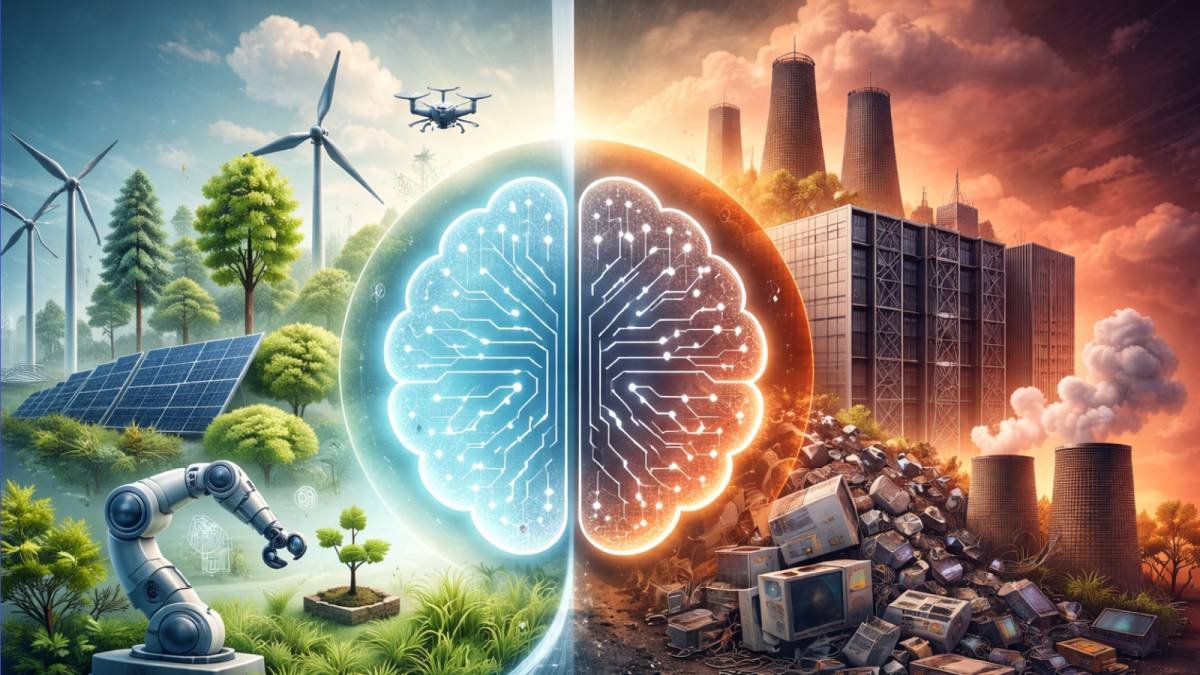
Artificial intelligence is transforming how people work, communicate, research, and solve problems. However, it also has an environmental impact because AI systems require powerful computers, data centers, electricity, and cooling.
Training and running AI models can consume significant resources, but AI can also support environmental solutions such as energy optimization, weather forecasting, deforestation monitoring, and waste reduction. Understanding both sides is important for developing and using AI responsibly.
What Is the Environmental Impact of AI?
The environmental impact of AI refers to the effects created by developing, training, operating, and maintaining artificial intelligence systems.
The main areas of concern include:
- Electricity consumption
- Carbon emissions
- Water use for cooling
- Manufacturing of computer chips and servers
- Electronic waste
- Construction and operation of data centers
- Mining and processing of raw materials
AI models don’t physically pollute the atmosphere themselves. Instead, their environmental footprint comes from the infrastructure required to create and operate them.
A small AI application running occasionally has a very different footprint from a large generative AI service processing millions of requests every day.
How AI Uses Energy
Training AI Models
Training is one of the most resource-intensive stages of AI development.
During training, powerful processors repeatedly analyze enormous datasets and adjust the model’s parameters. Modern AI systems can contain billions of parameters, requiring substantial computational capacity.
Training may involve:
- Thousands of processors operating simultaneously.
- Large data centers running continuously.
- Cooling equipment removing heat from computing hardware.
- Networking equipment moving data between machines.
- Storage systems holding datasets and model checkpoints.
The amount of electricity required varies considerably depending on the model, hardware, training method, duration, and data-center efficiency.
Running AI Models
Training isn’t the only source of energy consumption.
Once a model has been trained, it needs computing power whenever someone uses it. This process is often called inference.
For popular AI services, inference can become a major part of total energy demand because the same model may answer millions or billions of requests.
Text generation, image generation, video generation, and other computationally intensive tasks can have different energy requirements. More complex outputs generally require more computation.
Carbon Emissions From AI
Electricity consumption doesn’t automatically equal carbon emissions. The environmental effect depends heavily on where the electricity comes from.
A data center powered largely by renewable electricity can have a substantially different carbon footprint from one operating primarily on fossil-fuel-generated electricity.
The carbon impact of AI therefore depends on several factors:
| Factor | Potential Environmental Effect |
| Electricity source | Determines how much carbon is associated with energy use |
| Model size | Larger models can require more computing resources |
| Hardware efficiency | Efficient chips can reduce energy per task |
| Data-center efficiency | Better infrastructure can reduce wasted energy |
| Utilization | Better use of available computing capacity can improve efficiency |
| Cooling method | Cooling can add both electricity and water demand |
| Model usage | Frequent or complex queries increase total resource consumption |
This is why simply asking whether “AI is bad for the climate” doesn’t provide a complete answer. The technology’s footprint depends on how it is built and operated.
AI and Water Consumption
Water is another important part of the environmental discussion.
Many data centers generate substantial heat, and cooling systems are needed to keep computing equipment operating safely. Depending on the facility’s design, cooling can involve water consumption.
Water may also be associated indirectly with electricity generation and the manufacturing of semiconductor hardware.
The exact amount of water used by an AI system is difficult to express as one universal number because it depends on:
- Data-center location
- Climate
- Cooling technology
- Electricity source
- Hardware efficiency
- Workload
- Facility design
- Time of year
This means estimates can vary significantly between facilities and applications.
The issue can become particularly important in areas where water resources are already under pressure.
Electronic Waste and Hardware
AI requires specialized hardware, including GPUs, accelerators, servers, networking equipment, storage devices, and other infrastructure.
As technology develops, companies may replace older hardware with newer and more efficient systems. That can create electronic waste, particularly when equipment reaches the end of its useful life.
Responsible hardware management can reduce this problem through:
- Reuse and refurbishment
- Recycling valuable materials
- Extending equipment lifespans
- Designing hardware for easier repair
- Responsible disposal
- Improving supply-chain transparency
The environmental story of AI therefore begins long before a model starts answering questions. It also includes the materials, factories, transportation, and infrastructure involved in producing the hardware.
Environmental Benefits of AI
AI can have environmental costs, but it can also provide useful tools for environmental protection.
Climate and Weather Research
Machine-learning systems can process enormous datasets and identify patterns that may be difficult to detect manually. Researchers can use AI to improve forecasting, analyze climate data, and study environmental changes.
Energy Grid Optimization
AI can help electricity providers forecast demand, identify unusual patterns, and coordinate energy resources.
This may become particularly useful as electricity systems incorporate variable renewable sources such as wind and solar power.
Renewable Energy Forecasting
Weather-dependent energy production can be difficult to predict. AI models can analyze weather and historical generation data to improve forecasts and help grid operators plan accordingly.
Agriculture
AI-powered systems can support precision agriculture by analyzing information about crops, soil, weather, and irrigation.
Better decision-making can potentially reduce unnecessary use of:
- Water
- Fertilizers
- Pesticides
- Fuel
Environmental Monitoring
AI can analyze satellite imagery and other sensor data to help identify changes in forests, oceans, land use, and ecosystems.
For example, machine learning can assist researchers in monitoring deforestation or detecting environmental changes over large geographic areas.
Factors That Determine AI’s Environmental Footprint
There isn’t one fixed environmental footprint for “AI.” Several variables matter.
1. Model Size
Larger models generally require more computing resources, although efficient architectures and optimization techniques can reduce the difference.
2. Hardware
Newer AI accelerators may perform substantially more computation per unit of electricity than older hardware.
3. Data Center Efficiency
Efficient facilities can reduce the energy required for cooling, power conversion, networking, and other supporting operations.
4. Electricity Mix
The source of electricity is critical. Renewable and low-carbon power can reduce operational emissions compared with carbon-intensive electricity.
5. Location
Climate and local infrastructure influence cooling requirements, electricity availability, and water consumption.
6. How AI Is Used
A simple classification task and a high-resolution video-generation request don’t require the same amount of computation.
How the AI Industry Can Reduce Its Environmental Impact
Reducing AI’s footprint doesn’t necessarily mean stopping AI development. It means improving efficiency throughout the technology’s lifecycle.
Use More Efficient Models
Developers can use smaller models when they provide sufficient performance instead of automatically selecting the largest available system.
Techniques such as model compression, quantization, pruning, and efficient architectures can reduce computational requirements.
Improve Hardware Efficiency
More efficient processors can perform more work while using less electricity. Hardware improvements can therefore play an important role in reducing energy consumption per AI task.
Use Cleaner Energy
Data centers can reduce operational carbon emissions by sourcing electricity from lower-carbon and renewable sources.
Improve Cooling Systems
More efficient cooling can reduce both electricity consumption and, depending on the technology, water demand.
Measure Environmental Performance
Companies should measure relevant indicators rather than making vague sustainability claims.
Useful measurements can include:
- Energy consumption
- Carbon emissions
- Water consumption
- Hardware utilization
- Computing efficiency
- Data-center efficiency
Transparent reporting makes it easier to compare improvements over time.
What Individuals and Businesses Can Do
Users don’t control the infrastructure behind every AI service, but they can still make thoughtful choices.
For Individuals
- Use AI when it provides meaningful value.
- Avoid unnecessarily generating large amounts of content.
- Choose efficient tools when appropriate.
- Be mindful of repeated or redundant requests.
- Support companies that provide meaningful sustainability information.
For Businesses
Businesses using AI at scale can:
- Select appropriately sized models.
- Optimize prompts and workflows to reduce unnecessary computation.
- Use efficient hardware and infrastructure.
- Track energy and environmental metrics.
- Consider the environmental characteristics of cloud and data-center providers.
- Reuse models and infrastructure where practical.
The goal isn’t to avoid AI completely. It’s to use computing resources intelligently.
Key Takeaways
- AI has an environmental footprint because it depends on electricity, data centers, hardware, and cooling infrastructure.
- Energy consumption can contribute to carbon emissions depending on the electricity source.
- Data-center cooling can require significant water resources in some locations.
- AI hardware manufacturing also creates environmental impacts and eventually contributes to electronic waste.
- Not every AI application has the same environmental footprint.
- Smaller models and efficient hardware can reduce computing requirements.
- Renewable and low-carbon electricity can lower operational emissions.
- AI can also support environmental protection through climate research, energy optimization, agriculture, and ecosystem monitoring.
- Responsible AI development requires considering environmental costs alongside performance and economic benefits.
FAQs
1. What is the environmental impact of AI?
AI affects the environment through energy use, carbon emissions, water consumption, hardware production, and e-waste.
2. Does AI contribute to climate change?
Yes. AI can contribute to emissions when its electricity comes from fossil fuels.
3. Does AI use a lot of water?
Some AI data centers use water for cooling, but usage varies by location and cooling system.
4. Is AI always bad for the environment?
No. AI can also help with renewable energy, climate research, agriculture, and environmental monitoring.
5. How can AI become more environmentally friendly?
Using efficient models, cleaner energy, better cooling, and energy-efficient hardware can reduce AI’s footprint.
6. Does a larger AI model always have a larger environmental impact?
Not always. Hardware, efficiency, energy sources, and usage also affect its environmental impact.
7. Can AI help fight climate change?
Yes. AI can support climate research, energy optimization, weather forecasting, and environmental monitoring.
Conclusion
The environmental impact of AI is becoming increasingly important as artificial intelligence expands across consumer products, businesses, research, and industry.
AI requires significant digital infrastructure, and that infrastructure consumes electricity, requires cooling, depends on physical hardware, and creates environmental effects throughout its lifecycle. At the same time, AI offers tools that can help society use energy, water, land, and other resources more efficiently.
The most useful question isn’t whether AI is simply “good” or “bad” for the environment. It’s how efficiently AI is developed, powered, deployed, and used.
Building smaller and more efficient models, improving hardware, using cleaner energy, reducing unnecessary computation, managing water responsibly, and measuring environmental performance can all help reduce AI’s footprint.
As AI continues to develop, environmental responsibility should be treated as part of good technology design—not as an afterthought.
Read More About: Machine Learning and Artificial Intelligence
