

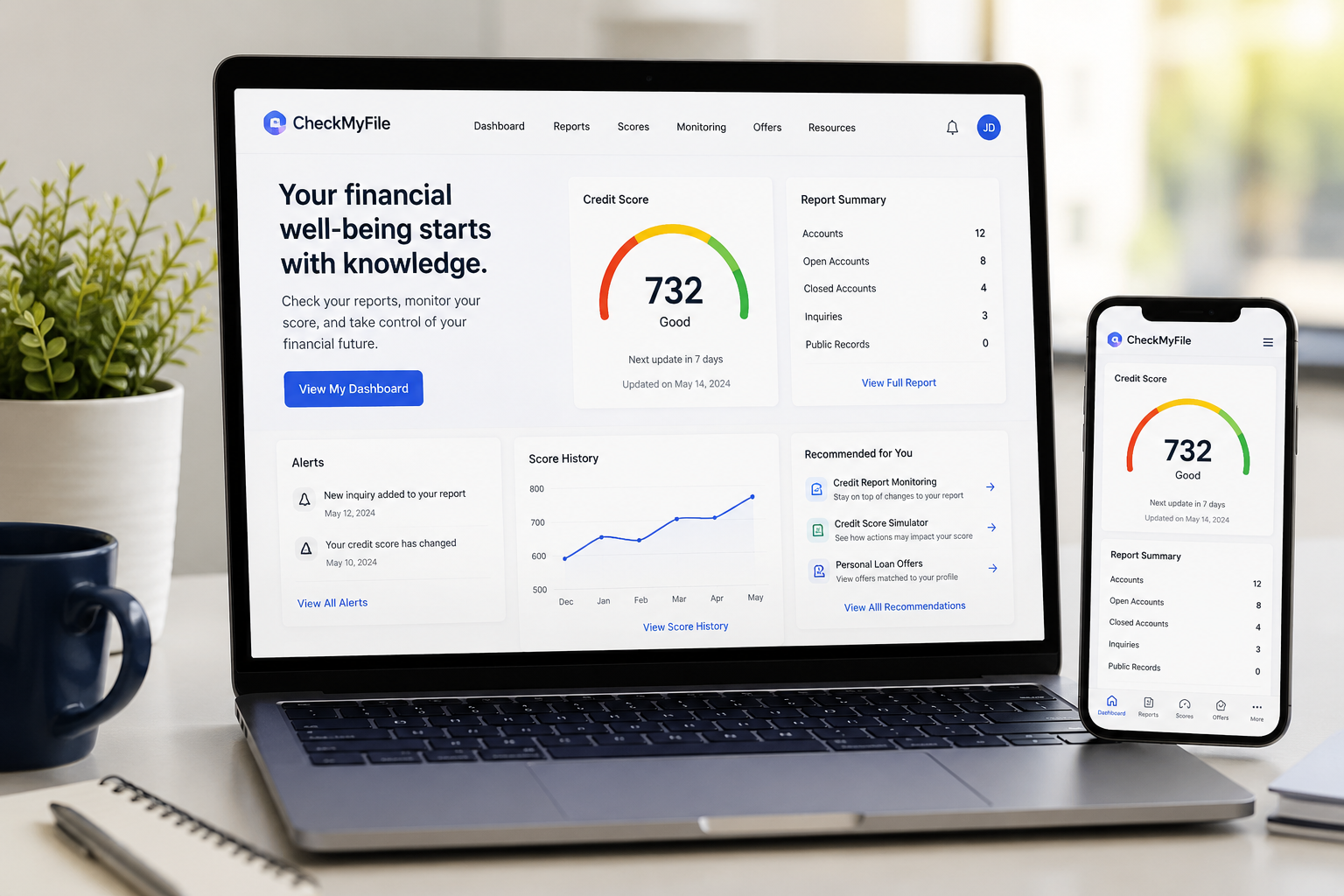
Keeping track of your credit report can make a big difference when you’re planning to apply for a mortgage, credit card, personal loan, mobile contract or other forms of borrowing. The challenge is that your information can appear differently across the UK’s major credit reference agencies.
Checkmyfile is designed to make that process easier by bringing credit information from Experian, Equifax and TransUnion together in one place. Instead of checking each agency separately, users can review a consolidated view of their credit history and see factors that may influence their credit score.
This guide explains what Checkmyfile is, what information it provides, how its credit score works, what you can check on your report, how the free trial works and what to do if you find an error.
What Is Checkmyfile?
Checkmyfile is a UK online credit-report and credit-score service operated by Credit Reporting Agency Limited. The company says it has provided UK consumers with online access to credit reports and scores since 2001. It combines information from the UK’s three main credit reference agencies: Experian, Equifax and TransUnion.
The main attraction is convenience. Rather than viewing separate reports from individual agencies, Checkmyfile presents information from the three agencies together.
This can be useful because credit reference agencies may hold different information about the same person. A lender may also use a particular agency or its own assessment process, so reviewing more than one source can give you a broader understanding of your credit profile.
How Does Checkmyfile Work?
Checkmyfile collects relevant information from the three main UK credit reference agencies and displays it through its online platform.
According to the service, its report can include up to six years of history from the three agencies.
After creating an account, users go through an identity-verification process. Checkmyfile explains that payment details are requested during registration partly to help verify the customer and allow the account to move from the free trial to a paid subscription if the customer continues.
The general process is:
- Create a Checkmyfile account.
- Provide the required personal and payment details.
- Complete the identity-verification questions.
- Access your credit report and score.
- Review the information from the three agencies.
- Investigate anything that appears inaccurate or unusual.
- Take appropriate steps to improve or maintain your credit profile.
What Information Can You See?
One of Checkmyfile’s main features is the amount of information presented in a single dashboard.
Its report can include the following areas:
| Report Section | What It Can Show |
| Credit score | Your current Checkmyfile score and factors affecting it |
| Payments & borrowing | Credit accounts, borrowing and payment history |
| Addresses | Current and previous address information |
| Electoral Roll | Electoral Roll registration details |
| Associations | People with whom you may have financial connections |
| Court information | Relevant court information held by credit agencies |
| Searches | Companies that have searched your credit file |
| Fraud alerts | Fraud-related notices recorded on your file |
Reviewing these sections regularly can help you identify information that you don’t recognise or details that may need correcting.
Payments and Borrowing
Your borrowing history is an important part of your credit file. Checkmyfile provides information about payment and borrowing history over a six-year period.
Look for:
- Missed or late payments
- Open and closed accounts
- Outstanding balances
- Credit limits
- Repayment patterns
- Older credit accounts
A history of consistently managing borrowing responsibly can support a healthier credit profile.
Addresses and Electoral Roll
Your address information also matters because credit agencies need to match your records accurately.
Checkmyfile allows users to see current and previous addresses and their Electoral Roll status.
Using consistent personal and address information when making applications can also reduce potential matching problems. Checkmyfile notes that differences in names or address formats can sometimes affect whether information is correctly matched to a credit report.
Checkmyfile Credit Score Explained
A credit score is a numerical representation used to help explain information in your credit report. However, it is important to understand that your Checkmyfile score is not the same thing as a lender’s final lending decision.
Lenders can use different credit reference agencies, internal criteria and affordability checks when assessing applications.
Checkmyfile says its score takes information from Experian, Equifax and TransUnion into account.
Some factors commonly associated with a stronger credit profile include:
- Making payments on time
- Keeping accounts well managed
- Maintaining accurate personal information
- Being registered on the Electoral Roll
- Demonstrating the ability to repay borrowing
- Maintaining accounts responsibly over time
Importantly, taking out lots of credit simply to increase a score isn’t recommended. Checkmyfile specifically notes that having more accounts does not automatically improve your score; the accounts need to be managed well.
Why Checking Your Credit Report Matters
Checking your credit report isn’t only about trying to achieve a high number. It is also about understanding what information lenders may see.
A regular review can help you:
Spot Incorrect Information
A wrong address, unfamiliar account or incorrect payment record could create problems if it remains unresolved.
Identify Unrecognised Activity
Unknown credit applications or accounts can be warning signs of fraud or identity misuse.
Prepare Before Applying for Credit
Reviewing your report before applying for a mortgage, loan or credit card gives you an opportunity to identify potential issues first.
Understand Your Financial Position
Seeing your borrowing, payments and credit searches together can give you a clearer picture of your overall credit health.
How to Use Checkmyfile
If you’re using the service for the first time, don’t simply look at the headline score and leave.
Instead, work through the report systematically.
Step 1: Check Your Personal Details
Make sure your name, addresses and other identifying information are accurate.
Step 2: Review Credit Accounts
Check every account and make sure you recognise it.
Step 3: Look at Payment History
Pay particular attention to missed payments, defaults or other negative information.
Step 4: Review Credit Searches
Check which businesses have searched your file and whether you recognise the activity.
Step 5: Check Financial Associations
Look at people financially linked to you and make sure those relationships are accurate.
Step 6: Investigate Alerts
Pay attention to fraud alerts or other notices that you don’t recognise.
Step 7: Save a Copy if Necessary
Checkmyfile provides an option to create and download a PDF copy of your report. The company recommends checking the report regularly because a saved PDF will not automatically reflect future changes.
How Much Does Checkmyfile Cost?
According to Checkmyfile’s current official website, new customers can start with a 7-day free trial. After the trial, the subscription is currently £14.99 per month. The company states that customers can cancel online at any time.
The free trial is subject to eligibility requirements. Checkmyfile says it is available to new customers aged 18 or over who live in the UK.
Before signing up, always check the current terms and pricing displayed during registration, as subscription terms can change.
What If You Find an Error?
Finding inaccurate information doesn’t necessarily mean your credit profile is permanently damaged.
Start by identifying exactly what appears to be wrong. For example, it could be:
- An account you don’t recognise
- An incorrect payment status
- An outdated address
- A wrongly recorded financial association
- Incorrect court information
- A credit search you don’t recognise
Checkmyfile provides a dispute-resolution service and customer support for issues relating to information on its reports.
It’s sensible to keep evidence supporting your position, such as account statements, correspondence or confirmation from the relevant lender.
Checkmyfile vs Checking One Credit Reference Agency
The biggest difference is the breadth of information presented in one place.
| Feature | Checkmyfile | Single Credit Agency |
| Experian data | Yes | Depends on provider |
| Equifax data | Yes | Depends on provider |
| TransUnion data | Yes | Depends on provider |
| Combined dashboard | Yes | Usually no |
| Credit score | Yes | Depends on provider |
| Credit history | Yes | Yes |
| Fraud information | Yes | Depends on provider |
| Paid subscription | Yes | Depends on provider |
Checkmyfile’s value is therefore less about replacing the underlying credit reference agencies and more about providing a consolidated view of information from them.
Tips for Maintaining a Healthy Credit Profile
Checking your report is only the first step. Your financial habits matter too.
Consider these practical habits:
- Pay bills and credit commitments on time.
- Review your credit report periodically.
- Keep your personal information accurate.
- Avoid unnecessary credit applications.
- Monitor accounts for suspicious activity.
- Don’t borrow simply to manufacture a higher credit score.
- Give yourself time to build a consistent repayment history.
There is no instant fix for every credit issue. Responsible financial behaviour over time is generally more useful than trying to manipulate a score.
Key Takeaways
- Checkmyfile is a UK credit-report and credit-score service.
- It combines information from Experian, Equifax and TransUnion in one place.
- Reports can contain information covering up to six years of history.
- Users can review borrowing, payments, addresses, Electoral Roll information, associations, searches, court information and fraud alerts.
- A Checkmyfile score should not be treated as a guarantee that a lender will approve an application.
- New eligible customers can currently access a 7-day free trial before the listed £14.99 monthly subscription applies.
- Checking your report regularly can help you identify inaccurate or unfamiliar information early.
FAQs
1. What is Checkmyfile?
Checkmyfile is a UK service that combines credit information from Experian, Equifax and TransUnion.
2. Is Checkmyfile free?
Eligible new customers can currently get a 7-day free trial, followed by a £14.99 monthly subscription.
3. Which credit agencies does Checkmyfile use?
It provides information from Experian, Equifax and TransUnion.
4. Does Checkmyfile improve your credit score?
No. It helps you monitor your credit information but doesn’t directly improve your score.
5. Can I download my Checkmyfile report?
Yes. You can download your credit report as a PDF from the dashboard.
6. Can Checkmyfile help find errors?
Yes. It offers support for disputing inaccurate information on your credit report.
7. Does Checkmyfile guarantee loan approval?
No. Lenders use their own criteria, scoring systems and affordability checks.
Conclusion
Checkmyfile provides a convenient way for UK consumers to review credit information from Experian, Equifax and TransUnion through a single service. Its detailed report can help users understand borrowing history, payment records, addresses, Electoral Roll information, financial associations, searches and fraud alerts.
The biggest benefit is having a broader view of your credit information rather than relying on a single credit reference agency. However, the service should be viewed as a monitoring and information tool, not a guarantee of credit approval.
If you’re preparing for a major financial application, regularly reviewing your credit file, correcting inaccurate information and maintaining responsible repayment habits can put you in a stronger position. Always check the latest Checkmyfile pricing and subscription terms before starting a trial or paid membership.
Learn About: AVAV Stock
