

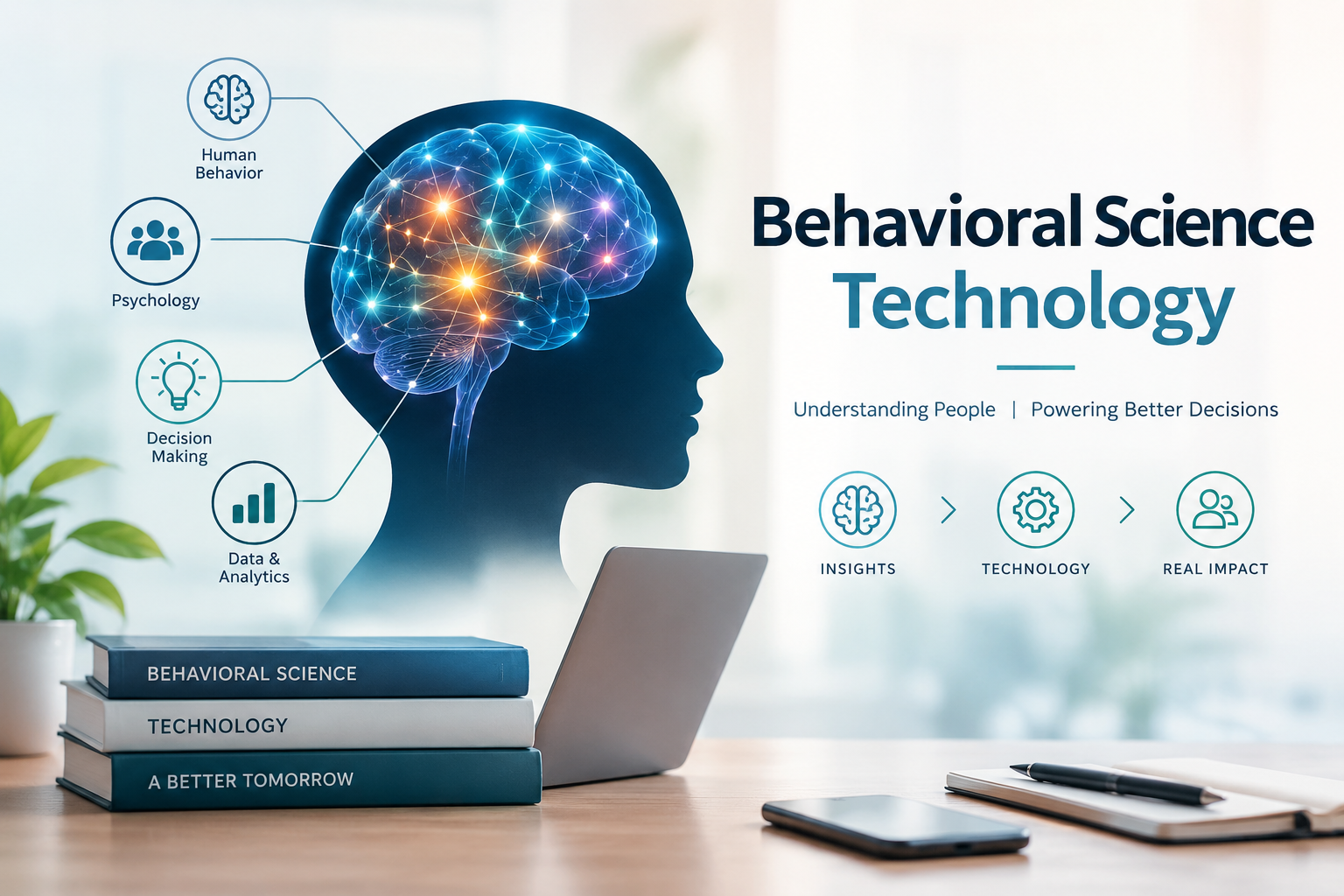
Behavioral science technology refers to the application of technology, data, and behavioral science principles to understand, analyze, predict, and responsibly influence human behavior. It brings together insights from fields such as psychology, behavioral economics, neuroscience, sociology, user research, and data analytics with modern digital technologies.
By examining how people think, make decisions, develop habits, and interact with products or services, organizations can identify behavioral patterns and use those insights to create more effective products, personalized experiences, smarter decision-making processes, and user-focused digital solutions. When applied responsibly, behavioral science technology can help businesses improve engagement, usability, customer experiences, and outcomes while maintaining transparency, privacy, and respect for user autonomy.
What Is Behavioral Science Technology?
Behavioral science technology sits at the intersection of human behavior and technology.
Behavioral science focuses on understanding why people think, choose, and act in particular ways. Technology, meanwhile, gives organizations increasingly sophisticated ways to collect information, identify patterns, test ideas, and create personalized experiences.
Put together, these fields can help answer practical questions such as:
- Why do users abandon an online purchase?
- What makes someone return to an app?
- Which information helps people make better decisions?
- Why does one message encourage action while another gets ignored?
- How can a digital product become easier and more intuitive to use?
The goal isn’t simply to collect more data. The real value comes from understanding the behavior behind the data and using that understanding to solve genuine problems.
For example, an analytics platform might show that many visitors leave a checkout page. Behavioral research can help determine why. Perhaps the form is confusing, unexpected fees appear too late, or users don’t understand what happens after they click the final button.
Technology can then be used to test improvements.
How Does Behavioral Science Technology Work?
There isn’t one single technology that defines the field. Instead, behavioral science technology can involve several methods and tools working together.
Behavioral Data
Digital products can generate information about how people interact with them. Depending on the context, this might include clicks, navigation patterns, searches, conversions, retention, or other forms of interaction data.
These signals can reveal patterns that aren’t immediately obvious.
Psychology and Behavioral Principles
Behavioral science provides frameworks for interpreting those patterns.
Concepts such as cognitive biases, motivation, habits, decision-making, attention, social influence, and friction can help explain why people behave differently in seemingly similar situations.
Experiments and A/B Testing
Organizations can test different versions of a website, feature, message, or user journey.
For instance, a company could compare two checkout designs to determine whether simplifying the process improves completion rates. The important point is that the behavioral hypothesis comes before the test rather than simply changing elements randomly.
Artificial Intelligence and Machine Learning
AI and machine learning can identify patterns across large datasets and support prediction or personalization.
However, algorithms don’t automatically understand human behavior. Behavioral science can provide the conceptual context needed to interpret patterns responsibly.
Why Behavioral Science Matters in Technology
Modern technology gives businesses access to enormous amounts of behavioral information. But more data doesn’t automatically mean better decisions.
A dashboard may tell a product team what happened, while behavioral science can help investigate why it happened.
This distinction is important.
Imagine a streaming service discovers that many users stop watching a particular type of content after several minutes. Simply knowing the drop-off point isn’t enough. Researchers might investigate whether the issue involves content expectations, navigation, attention, recommendations, or something else.
That combination of quantitative data and behavioral understanding can produce more useful decisions.
It also encourages organizations to design around real human needs instead of assumptions.
Where Is Behavioral Science Technology Used?
Behavioral science technology can be applied across many industries.
| Industry | Potential Use |
| E-commerce | Improving shopping journeys and reducing unnecessary friction |
| Financial services | Supporting clearer financial decisions and user engagement |
| Healthcare | Encouraging appropriate engagement with services and information |
| Education | Supporting learning habits and student engagement |
| Marketing | Understanding customer behavior and testing messaging |
| Software | Improving onboarding, usability, and retention |
| Public services | Making digital services easier to access and navigate |
| Human resources | Understanding workplace experiences and decision processes |
The exact methods depend on the objective, available data, and environment.
Examples in Everyday Digital Experiences
You may already encounter behavioral science technology without realizing it.
Personalized Recommendations
Online platforms often recommend products, articles, videos, or other content based on previous interactions.
The technology analyzes behavioral signals, while behavioral research can help determine how recommendations should be presented in a way that’s useful rather than overwhelming.
Simplified Sign-Up Processes
A long registration form can create unnecessary friction. Product teams can study where users hesitate or leave and redesign the experience.
The improvement might be as simple as removing unnecessary fields or explaining why information is needed.
Reminder and Notification Systems
Reminders can help users return to unfinished tasks or remember important activities. But excessive notifications can become distracting.
Behavioral science can help teams think about timing, relevance, motivation, and user control instead of treating every notification as an opportunity for engagement.
Website Design
Small design decisions can affect how easily people find information and complete tasks.
Clear labels, understandable navigation, useful feedback, and logical page structures can reduce cognitive effort and make digital experiences easier to use.
The Benefits of Combining Behavioral Science and Technology
When used carefully, this approach can create value for both organizations and users.
Better User Experiences
Understanding user behavior can help businesses identify confusing or frustrating parts of a product.
More Informed Decisions
Behavioral data can complement traditional market research and provide evidence about how people actually interact with a product.
More Effective Product Development
Instead of relying entirely on opinions, teams can form hypotheses, test them, observe behavior, and refine their products.
Improved Personalization
Behavioral signals can support more relevant experiences when personalization is transparent and genuinely useful.
Greater Efficiency
Identifying unnecessary steps in a customer or employee journey can help organizations simplify processes and reduce wasted effort.
Ethical Challenges to Consider
Behavioral technology isn’t automatically beneficial. The same techniques that can make products more useful can also be used to manipulate people.
This is why ethics, privacy, transparency, and user autonomy matter.
Organizations should consider questions such as:
- Is the data being collected necessary?
- Do users understand how their information is being used?
- Can users make meaningful choices?
- Is personalization helping users or exploiting vulnerabilities?
- Are behavioral interventions designed around user interests?
- Could an algorithm produce unfair or discriminatory outcomes?
There’s an important difference between persuasion and manipulation.
A well-designed reminder might help someone complete an important task. A deliberately confusing interface designed to push someone toward an unwanted purchase is a different matter.
Responsible behavioral technology should aim to create mutual value, not simply maximize clicks or conversions.
How Businesses Can Use Behavioral Science Responsibly
Companies interested in this field don’t necessarily need a massive technology stack.
A practical approach can start with a clear problem.
1. Define the Behavioral Question
Don’t begin with “What data can we collect?”
Start with a question such as: Why are customers abandoning this process?
2. Combine Data With Research
Analytics can reveal patterns, while surveys, interviews, usability testing, and observation can provide context.
3. Create a Testable Hypothesis
If users are abandoning a form, determine what might be causing the problem and design a specific intervention.
4. Test and Measure
Use controlled experiments or other appropriate research methods to determine whether the change actually works.
5. Protect User Autonomy
Make privacy choices clear, avoid deceptive design, and give people appropriate control over their experience.
6. Keep Reviewing the Results
Behavior can change over time. A solution that works today shouldn’t automatically be treated as a permanent answer.
FAQs About Behavioral Science Technology
What does behavioral science technology mean?
Behavioral science technology combines behavioral science principles with digital tools, data, analytics, experiments, and other technologies to understand and improve human behavior and decision-making.
Is behavioral science technology the same as artificial intelligence?
No. AI can be one component of behavioral science technology, but the field is broader. It can also involve psychology, behavioral economics, user research, experimentation, analytics, and product design.
Where is behavioral science technology used?
It can be used in e-commerce, healthcare, education, financial services, software, marketing, public services, and many other areas where understanding human behavior is important.
How does behavioral science improve websites?
It can help teams understand where users experience confusion or friction and test changes to navigation, content, forms, calls to action, and other parts of the user journey.
Is behavioral science technology ethical?
It can be, provided it is used responsibly. Privacy, transparency, informed choices, fairness, and respect for user autonomy are important considerations.
Why is behavioral data useful?
Behavioral data can show how people actually interact with a product or service. When combined with qualitative research, it can help organizations understand patterns and make better-informed decisions.
What is the difference between behavioral science and behavioral analytics?
Behavioral science is the broader study of how people think and behave. Behavioral analytics generally focuses on analyzing data about user actions to identify patterns and trends. The two can work together.
Conclusion
Behavioral science technology brings together an understanding of human behavior with the capabilities of modern technology. Rather than treating users as numbers on a dashboard, it encourages organizations to look deeper into the motivations, decisions, habits, and obstacles behind those numbers.
Its strongest applications aren’t necessarily the most complicated ones. A clearer form, a better recommendation, a more useful reminder, or a simpler digital journey can all result from understanding behavior more effectively.
As technology becomes increasingly personalized and data-driven, the most important question isn’t just what technology can influence. It’s whether that influence creates a better experience while respecting the people using it.
Learn More About: Technology and Science
