

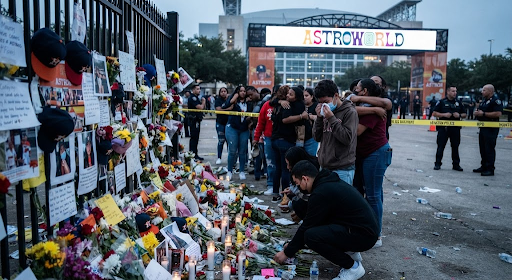
The Astroworld Festival in Houston was meant to be a major night of music and entertainment. Instead, the event turned tragic on November 5, 2021, when a massive crowd surge occurred during Travis Scott’s performance.
The crowd became dangerously compressed near the stage, leaving many people unable to move or breathe. Ten people died and hundreds were injured, making Astroworld one of the most tragic concert disasters in recent U.S. history.
The incident later sparked serious questions about crowd control, emergency response, event planning, and overall concert safety.
What Happened at Astroworld?
The Astroworld Festival took place at NRG Park in Houston, Texas. The event featured several performers, with Travis Scott scheduled as the headline act.
As Scott began his set on the evening of November 5, the crowd became increasingly dense in front of the stage. People pushed toward the performance area, creating intense pressure within sections of the audience.
Witnesses and videos from the event showed people attempting to escape the packed area, while others called for help or tried to alert security personnel.
The situation eventually became a major medical emergency.
According to reporting on the subsequent investigation and lawsuits, festival workers had raised concerns about crowd conditions and safety. The Houston Police Department later released a nearly 1,300-page investigative report examining what happened before, during and after the concert.
For readers interested in how unfamiliar ideas and terms can develop attention online, a separate discussion of language, meaning and emerging concepts can be found in this guide to Poieno. It is unrelated to the Astroworld incident, but it provides an example of how online topics can develop their own explanations and interpretations.
How Did the Crowd Surge Develop?
A crowd surge is different from ordinary movement in a busy audience.
When thousands of people are standing close together, even a relatively small movement can create powerful pressure. Individuals may lose control of where they are going because they are being pushed by people around them.
At extreme densities, people may be unable to:
- Move their arms freely
- Turn around or change direction
- Reach emergency exits
- Help people who have fallen
- Breathe normally
This appears to have played a central role in the Astroworld tragedy.
The crowd near the stage became so tightly packed that some attendees could no longer move independently. Emergency situations developed within the audience as people were crushed against one another.
The danger was particularly severe because a person caught in the middle of a dense crowd may have little ability to protect themselves or create space.
Astroworld Houston Deaths and the Victims
One of the most painful aspects of the tragedy was the age range of those who died.
The 10 victims were between 9 and 27 years old. The youngest was Ezra Blount, a 9-year-old boy from Dallas. He was attending the concert with his father and was initially on his father’s shoulders when the crowd became dangerously compressed. He was later found severely injured and died several days after the festival.
The victims included:
| Victim | Age |
| Ezra Blount | 9 |
| John Hilgert | 14 |
| Brianna Rodriguez | 16 |
| Franco Patino | 21 |
| Axel Acosta | 21 |
| Bharti Shahani | 22 |
| Jacob Jurinek | 20 |
| Madison Dubiski | 23 |
| Danish Baig | 27 |
| Rodolfo “Rudy” Peña | 23 |
Their deaths were not caused by a single isolated medical event. The medical findings pointed to the physical effects of the crowd compression.
Remembering the victims is important because the event was not simply a headline or a concert that went wrong. Each death represented a person with family, friends, plans and a life outside the festival.
What Caused the Deaths?
The official cause of death for the 10 victims was compression asphyxia.
Compression asphyxia happens when intense external pressure prevents the chest from expanding normally. When a person cannot breathe properly for long enough, oxygen levels can fall to dangerous levels.
In a severe crowd crush, the pressure can become overwhelming.
Experts discussing the Astroworld deaths compared the force involved to being crushed under something extremely heavy. The victims ranged from children to young adults, demonstrating how quickly a crowd emergency can become fatal.
This is why crowd safety is more than simply having enough security guards. Effective event safety also involves:
- Crowd-density monitoring
- Emergency access routes
- Clear communication systems
- Medical teams
- Barriers designed for crowd movement
- Trained security personnel
- Rapid decision-making
- The ability to stop an event when necessary
Emergency Response and Concert Shutdown
As reports of medical emergencies increased, efforts were made to respond to people in distress.
Videos from the event showed emergency personnel attempting to reach individuals within the crowd. The situation was difficult because the same density that created the injuries also made it challenging for responders to move through the audience.
One major question after the tragedy was why the concert did not stop sooner.
Travis Scott has said he was not aware of the full severity of what was happening in the crowd while performing. His attorneys later argued that his responsibilities were primarily related to performing and creative aspects of the festival rather than overall safety operations.
Attorneys representing victims and their families disputed that position and argued that Scott had responsibilities connected to the event and should have acted differently.
These competing arguments became an important part of the later civil litigation.
Investigation Into the Astroworld Tragedy
Following the festival, the Houston Police Department conducted a major investigation.
Investigators examined:
- Security planning
- Festival operations
- Crowd movement
- Emergency response
- Communications
- The actions of performers and organizers
- Reports from workers and attendees
- Video footage from the event
The investigation produced a report of nearly 1,300 pages. It included interviews and information concerning safety concerns that had been raised around the event.
Despite the extensive investigation, no criminal charges were filed against Travis Scott, and a grand jury declined to indict him and five other people connected with the festival.
That distinction is important. A decision not to pursue criminal charges does not mean that every question about the event disappeared. Civil lawsuits continued to examine allegations involving negligence, responsibility and event safety.
Lawsuits and Legal Developments
The Astroworld tragedy resulted in thousands of legal claims.
More than 4,000 people filed lawsuits connected to deaths and injuries from the festival. Plaintiffs alleged that event planning and safety measures were inadequate. Scott, Live Nation and other defendants denied liability and maintained that safety was a priority.
The legal process involved many defendants, including:
- Travis Scott
- Live Nation
- Companies associated with festival operations
- Apple, which livestreamed the performance
- Other individuals and organizations connected to the event
In 2024, the remaining wrongful-death lawsuit involving Ezra Blount’s family was settled. Earlier that month, attorneys had announced that the other nine wrongful-death cases had also been resolved. The settlement terms were confidential.
The civil litigation demonstrated how complicated responsibility can become after a large public event goes wrong. Criminal liability, civil liability and moral responsibility are separate legal and social questions.
Why Astroworld Changed Concert Safety Discussions
The Astroworld tragedy became a major case study in the risks associated with large concerts.
The incident showed that a concert can become dangerous even when the event appears organized from the outside. Crowd behavior can change rapidly, especially when a headline performer begins a highly anticipated set.
For event organizers, the tragedy highlighted the need for strong emergency planning before the first performer even takes the stage.
Large events should have clearly defined answers to questions such as:
- Who has authority to stop the performance?
- How quickly can medical teams reach the audience?
- How is crowd density monitored?
- How are emergencies communicated to performers?
- Can security teams communicate across different parts of the venue?
- What happens if crowd movement becomes uncontrollable?
These questions are relevant far beyond music festivals.
Lessons From the Tragedy
The Astroworld disaster also offers broader lessons about public safety.
Large gatherings require preparation for situations that may seem unlikely. Organizers cannot rely only on normal crowd behavior.
A successful safety plan should include prevention, monitoring and rapid intervention.
There is also a human element. Attendees need to recognize warning signs and know when to move away from an increasingly dangerous area. Organizers, meanwhile, need systems that allow them to react before conditions become catastrophic.
Public crises can also change everyday behavior long after the original event. A broader look at how major disruptions affected routines, communication and social life can be found in this overview of lockdown life.
The link is not a source about Astroworld; rather, it provides wider context for understanding how major events can influence public behavior and everyday life.
Key Takeaways
- The Astroworld Festival tragedy occurred in Houston on November 5, 2021.
- Ten people died during the crowd crush.
- The victims ranged in age from 9 to 27.
- Their deaths were attributed to compression asphyxia.
- Hundreds of other attendees were injured.
- Houston police conducted an extensive investigation.
- A grand jury declined to indict Travis Scott and five others.
- Thousands of civil claims were filed after the festival.
- All 10 wrongful-death lawsuits were eventually settled confidentially.
- The tragedy remains an important example of why crowd safety and emergency planning matter.
FAQs
How many people died at Astroworld?
Ten people died as a result of the crowd crush at the Astroworld Festival in Houston on November 5, 2021.
What caused the Astroworld deaths?
The 10 victims died from compression asphyxia, which occurred when intense pressure from the tightly packed crowd prevented them from breathing normally.
How old was the youngest Astroworld victim?
The youngest victim was Ezra Blount, who was 9 years old. He died several days after the festival from injuries sustained during the crowd crush.
Was Travis Scott charged over Astroworld?
No. After the Houston Police Department investigation, a grand jury declined to indict Travis Scott and five others on criminal charges related to the tragedy.
Were the Astroworld lawsuits settled?
Yes. All 10 wrongful-death lawsuits had been settled by May 2024. The terms of the settlements were confidential.
Did people get injured at Astroworld?
Yes. Hundreds of people were injured during the crowd surge, and thousands of civil claims were later filed in connection with injuries and emotional distress.
Conclusion
The Astroworld tragedy remains a painful reminder of how quickly a large entertainment event can become a life-threatening situation. Ten people lost their lives, hundreds were injured, and many more were affected emotionally.
The investigation and lawsuits raised difficult questions about crowd control, emergency response and responsibility. While the criminal investigation did not result in indictments, the civil cases highlighted the continuing importance of event safety.
The most lasting lesson from Astroworld is simple: large crowds require serious planning, constant monitoring and the ability to respond immediately when conditions become dangerous.
