

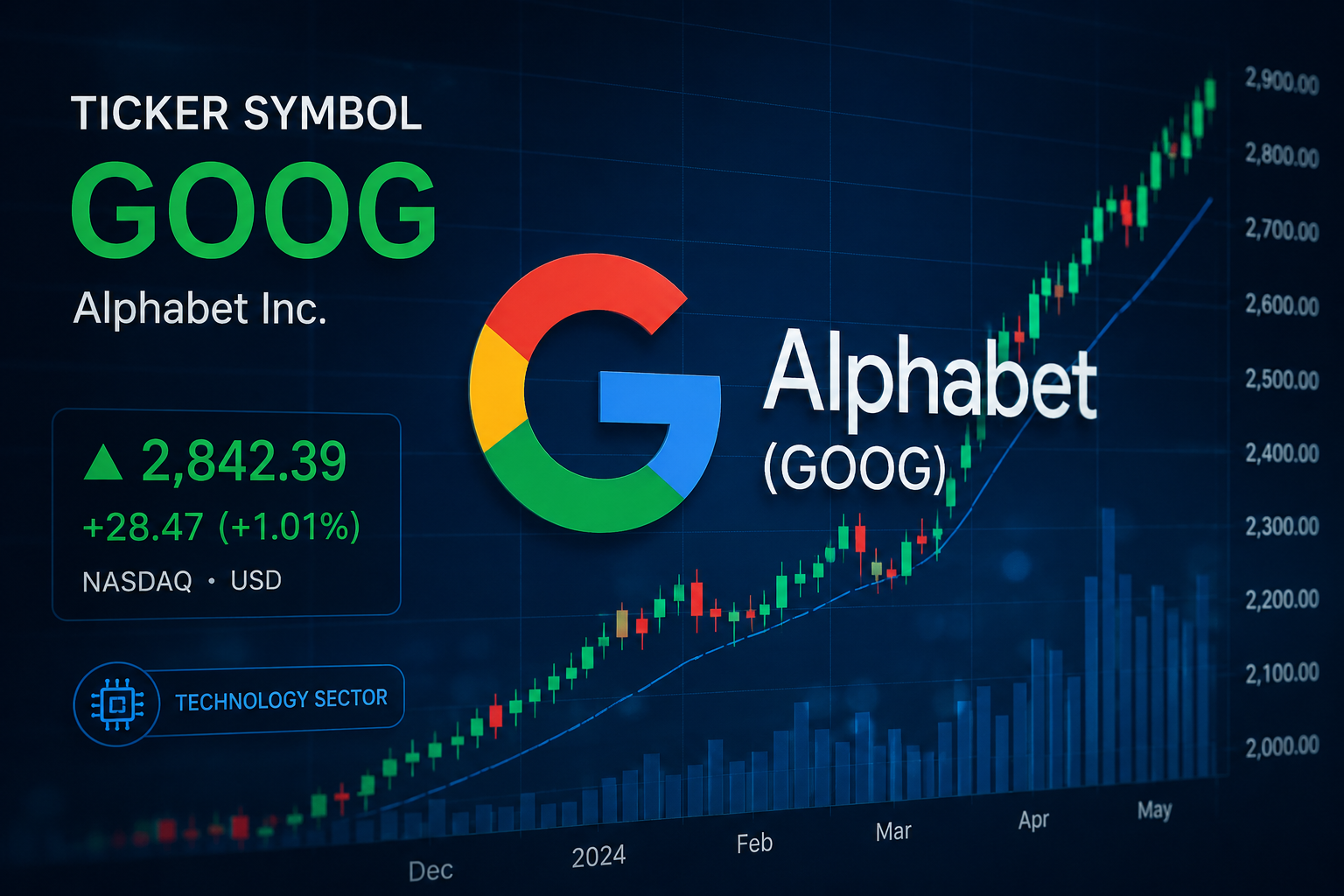
If you’ve searched for the ticker symbol GOOG, you’re probably trying to understand what the symbol represents, how it relates to Google, or whether GOOG is different from GOOGL.
The short answer is simple: GOOG is the stock ticker for Alphabet Inc. Class C capital stock. Alphabet is the parent company of Google and several other businesses. Its Class A common stock trades under GOOGL, while its Class C capital stock trades under GOOG.
The difference between these two tickers is important because the shares have different voting rights. Understanding that distinction can help investors interpret stock quotes, financial news, and company filings more accurately.
This guide explains what GOOG means, how it works, how GOOG compares with GOOGL, and what investors should consider before making an investment decision.
What Is the Ticker Symbol GOOG?
The ticker symbol GOOG identifies Alphabet Inc.’s Class C capital stock on Nasdaq.
Alphabet officially lists its Class A common stock under GOOGL and its Class C capital stock under GOOG. Both securities trade on the Nasdaq Global Select Market.
A stock ticker is a short combination of letters used to identify a publicly traded security. Instead of writing the company’s full legal name every time, financial websites and exchanges use symbols such as GOOG.
For example:
| Ticker | Security | Voting Rights |
| GOOG | Alphabet Class C capital stock | No voting rights |
| GOOGL | Alphabet Class A common stock | One vote per share |
| Class B | Alphabet Class B shares | Ten votes per share |
Nasdaq also identifies GOOG as Alphabet Class C and GOOGL as Alphabet Class A.
Who Owns the GOOG Ticker?
The GOOG ticker belongs to Alphabet Inc., the parent company of Google.
Alphabet became Google’s parent company following Google’s corporate restructuring. Today, Alphabet’s business portfolio extends beyond its core search engine and includes areas such as cloud computing, artificial intelligence, advertising, hardware, and other technology businesses.
This is why financial information may refer to “Alphabet stock” rather than simply “Google stock.” Google remains Alphabet’s best-known business, but Alphabet is the publicly traded parent company.
GOOG vs. GOOGL: What’s the Difference?
One of the most common questions about the ticker symbol GOOG is how it differs from GOOGL.
The primary distinction is voting power.
GOOG: Class C
GOOG represents Alphabet’s Class C capital stock. These shares generally do not carry voting rights.
GOOGL: Class A
GOOGL represents Alphabet’s Class A common stock. These shares carry one vote per share.
For many investors, both securities provide economic exposure to Alphabet. However, the voting-rights difference can influence how the shares trade.
A Simple Example
Suppose an investor wants exposure to Alphabet but does not care about shareholder voting rights. GOOG may be worth comparing with GOOGL because the two classes represent different forms of Alphabet stock.
An investor who wants voting rights may instead prefer to consider GOOGL.
The choice should not be based on the ticker alone. Investors should also compare the current prices, share structure, tax considerations, brokerage costs, and their individual investment objectives.
Why Does Alphabet Have Multiple Share Classes?
Alphabet’s multi-class share structure is designed to separate economic ownership from voting control.
The three main classes are:
- Class A: One vote per share.
- Class B: Ten votes per share and generally held by founders and certain insiders.
- Class C: No voting rights.
This structure allows founders and other holders of high-vote shares to retain significant influence over corporate decisions while public investors can own shares in the company.
Multi-class structures are not unique to Alphabet. Nasdaq explains that companies sometimes issue different stock classes to provide different levels of voting power to shareholders.
How GOOG Shares Work
Buying GOOG means purchasing a security representing an ownership interest in Alphabet.
However, owning GOOG does not mean you directly own Google’s search engine as a separate public company. Google operates within Alphabet’s corporate structure.
GOOG investors are therefore exposed to Alphabet’s overall financial performance.
Several major factors can influence that performance.
Advertising Revenue
Google’s advertising business remains an important part of Alphabet’s operations. Changes in digital advertising demand can affect revenue and investor expectations.
Google Cloud
Cloud computing is another important part of Alphabet’s business. Growth in cloud services can influence how investors view the company’s longer-term opportunities.
Artificial Intelligence
AI has become a major focus across the technology industry. Alphabet’s investments in AI, including products and infrastructure, can affect future growth expectations and market sentiment.
Other Businesses
Alphabet also has operations and investments beyond its best-known Google products. These businesses can create additional growth opportunities but may also involve significant costs and uncertainty.
What Can Affect the GOOG Stock Price?
The price of GOOG can change for many reasons. Investors should avoid assuming that a strong company will always have a rising stock price.
Common influences include:
- Quarterly earnings: Revenue, profit, and management guidance can affect investor expectations.
- Advertising trends: Changes in online advertising demand can influence Alphabet’s financial results.
- AI developments: New AI products, competition, and investment costs can move market sentiment.
- Regulatory developments: Government actions involving technology companies can affect valuation and operations.
- Interest rates: Changes in rates can influence how investors value growth-oriented companies.
- Market sentiment: Broader movements in technology stocks can affect GOOG even when company-specific news is limited.
- Competition: Alphabet competes across search, cloud, advertising, AI, hardware, and other markets.
GOOG is also included among Nasdaq-listed companies and is a component of the Nasdaq-100.
What Investors Should Check Before Buying GOOG
Finding the ticker symbol GOOG is only the first step in researching the stock. Investors should look beyond the current share price.
1. Review Financial Results
Look at revenue growth, operating income, net income, cash flow, and other important financial measures.
2. Compare GOOG and GOOGL
Because Alphabet has two publicly traded share classes, compare their prices and voting characteristics rather than automatically choosing one.
3. Consider Valuation
A high-quality company can still be an expensive investment. Investors should consider valuation alongside growth expectations and financial performance.
4. Read Company Filings
Alphabet’s regulatory filings provide detailed information about its financial condition, risks, business segments, and share structure.
5. Think Long Term
Stock prices can fluctuate significantly over short periods. A long-term investor should consider whether Alphabet fits their broader portfolio and risk tolerance.
6. Avoid Decisions Based on One Metric
A single stock-price movement, analyst opinion, or headline rarely provides enough information for an investment decision.
Key Takeaways
- GOOG is the ticker symbol for Alphabet Inc. Class C capital stock.
- GOOG trades on the Nasdaq Stock Market.
- GOOGL represents Alphabet Class A shares.
- GOOG shares generally have no voting rights, while GOOGL shares have one vote per share.
- Alphabet is Google’s parent company.
- GOOG’s performance can be influenced by advertising, cloud computing, AI, competition, regulation, interest rates, and broader market conditions.
- Investors should research both the company and the specific share class before investing.
FAQs
What is the ticker symbol GOOG?
GOOG is the Nasdaq ticker for Alphabet Inc. Class C capital stock.
Is GOOG the same as Google?
GOOG represents Alphabet stock, while Google is a major business operated by Alphabet.
What is the difference between GOOG and GOOGL?
GOOG is Class C stock with no voting rights, while GOOGL is Class A stock with one vote per share.
Is GOOG listed on Nasdaq?
Yes. Alphabet’s Class C shares trade under GOOG on Nasdaq.
Does GOOG have voting rights?
Generally, no. Alphabet’s Class C shares do not carry voting rights.
Is GOOG a technology stock?
GOOG represents Alphabet, a major technology-focused company with businesses spanning advertising, cloud, AI, and other digital services.
Conclusion
The ticker symbol GOOG represents Alphabet Inc.’s Class C capital stock and is one of the two primary publicly traded Alphabet share classes. The other, GOOGL, represents Class A common stock.
The most important difference is voting power: GOOG generally has no voting rights, while GOOGL carries one vote per share.
Learn About: Viva Finance
