

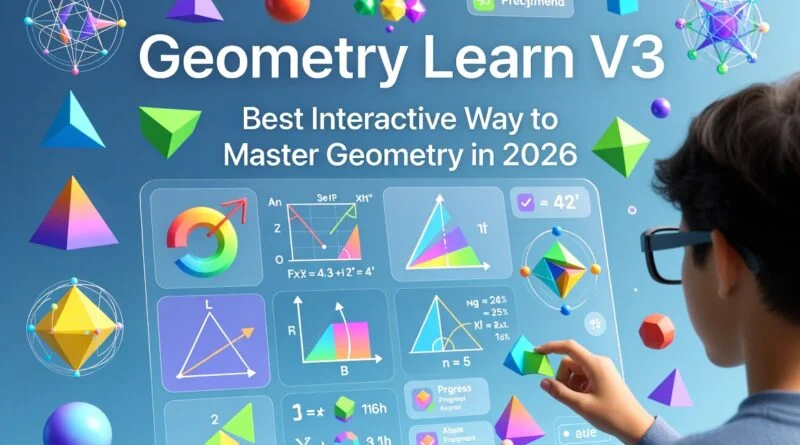
Have you ever looked at a geometry problem and thought, Why does this feel harder than it should be? I remember struggling with simple angle questions in school. The formulas weren’t the issue. It was the way geometry was taught—lots of memorization, very little visualization.
That’s probably why tools and learning systems like geometry learn v3 are getting attention. They focus less on forcing students to remember rules and more on helping them actually see how geometry works.
And honestly, that changes everything.
What Is Geometry Learn V3?
At its core, geometry learn v3 is designed to make geometry easier to understand through interactive learning methods. Instead of treating mathematical shapes as abstract concepts on paper, it encourages learners to explore points, lines, angles, and figures in a more visual way.
Geometry has always been different from other branches of mathematics. You can’t simply memorize your way through it. You need to imagine how shapes move, how angles connect, and why certain rules exist.
That’s where modern geometry learning platforms stand out. They bridge the gap between theory and practical understanding.
Why Students Often Struggle With Geometry
Geometry seems simple at first.
A few triangles here, a couple of circles there.
Then suddenly you’re dealing with proofs, theorems, and coordinate planes. Things become confusing pretty quickly.
Visualization Is the Biggest Challenge
Many students don’t struggle because they’re bad at math. They struggle because they can’t picture what’s happening.
For example, when someone explains how the interior angles of a triangle always add up to 180 degrees, it makes sense only after you actually see it demonstrated.
Interactive geometry tools make this process far easier.
Memorizing Formulas Isn’t Enough
I knew students who could recite every formula in the textbook but still froze during exams.
Geometry requires reasoning.
You need to ask questions like:
- Why does this angle equal that one?
- What happens if the shape rotates?
- Why are these triangles considered similar?
Those small questions lead to real understanding.
Key Features That Make Geometry Learning Easier
Interactive Diagrams
Static textbook images can only do so much.
Interactive diagrams allow learners to move shapes, resize figures, and immediately observe changes. A rectangle turning into a square or a triangle changing angles becomes much easier to grasp when you can manipulate it yourself.
Step-by-Step Problem Solving
One thing students appreciate is seeing the process instead of just the answer.
Breaking a geometry problem into smaller steps reduces frustration and builds confidence. Even difficult topics like coordinate geometry start feeling manageable.
Better Concept Retention
People remember experiences more than explanations.
I still remember constructing geometric shapes with paper and rulers during school days. Those activities stayed with me far longer than any formula written on the board.
Learning systems that encourage interaction often create the same effect.
How Geometry Helps Beyond the Classroom
Sometimes students ask, “When will I ever use this?”
Fair question.
But geometry quietly appears almost everywhere.
Architecture and Design
Buildings, bridges, room layouts, and even furniture design rely heavily on geometric principles. Architects constantly work with shapes, measurements, and spatial relationships.
Technology and Gaming
Video games use geometric calculations for movement, perspective, and object placement.
Even smartphone applications and computer graphics depend on geometry more than most people realize.
Everyday Problem Solving
Parking a car, arranging furniture in a small room, or estimating distances—these are all practical examples of spatial thinking.
And geometry trains exactly that skill.
Why Geometry Learn V3 Appeals to Modern Learners
Traditional teaching methods aren’t disappearing, but learning preferences have definitely changed.
Students today are used to interactive experiences. They expect information to be visual, engaging, and easier to explore.
That’s one reason geometry learn v3 resonates with many learners. It aligns with how people naturally absorb information today—through observation, experimentation, and immediate feedback.
And honestly, learning becomes less intimidating when you can actually interact with the concepts.
Tips for Learning Geometry More Effectively
Draw Everything
Even rough sketches help.
A poorly drawn triangle is still better than trying to solve a problem entirely in your head.
Understand the Logic
Don’t rush to memorize formulas.
Ask why they work.
That extra minute of curiosity often saves hours of confusion later.
Practice Small Problems Regularly
Geometry improves with repetition.
Ten minutes a day can be surprisingly effective. The brain gradually starts recognizing patterns and relationships between shapes.
Use Visual Learning Resources
Interactive platforms, digital diagrams, and geometry applications can make difficult concepts feel much more approachable.
And sometimes all it takes is seeing one moving diagram for everything to suddenly click.
The Future of Geometry Education
Education is becoming increasingly personalized.
Students no longer need to rely entirely on one teaching method or one classroom explanation. Modern learning tools allow people to move at their own pace, revisit difficult concepts, and experiment freely.
The growing interest in geometry learn v3 reflects this shift toward more engaging and learner-focused education.
Geometry itself hasn’t changed.
The way we learn it has.
And that’s probably for the better.
Final Thoughts
Geometry has a reputation for being difficult, but I don’t think the subject is the real problem. Often, it’s the approach.
When shapes become interactive and concepts become visual, geometry starts feeling less like a collection of rules and more like a puzzle waiting to be solved.
There’s actually something satisfying about finally understanding why lines intersect the way they do or why certain patterns repeat across different shapes. That moment when everything makes sense—it sticks with you.
And for many learners today, modern approaches are making those moments happen much faster.
Frequently Asked Questions
What is Geometry Learn V3?
Geometry Learn V3 is a modern approach or learning platform that focuses on interactive geometry education, helping students understand mathematical concepts through visualization and practical exploration.
Is geometry difficult for beginners?
It can feel challenging at first, mainly because geometry requires visual thinking. With regular practice and interactive learning methods, most students become comfortable with it over time.
Why is geometry important in real life?
Geometry is used in architecture, engineering, computer graphics, design, navigation, and many everyday tasks involving shapes and space.
How can students improve their geometry skills?
Drawing figures, practicing consistently, understanding concepts instead of memorizing formulas, and using visual learning tools can significantly improve geometry skills.
Can interactive learning improve geometry understanding?
Yes. Interactive methods often make abstract concepts easier to understand because learners can directly observe how shapes, angles, and measurements change.
Read More About: Geometry Learn V3
