

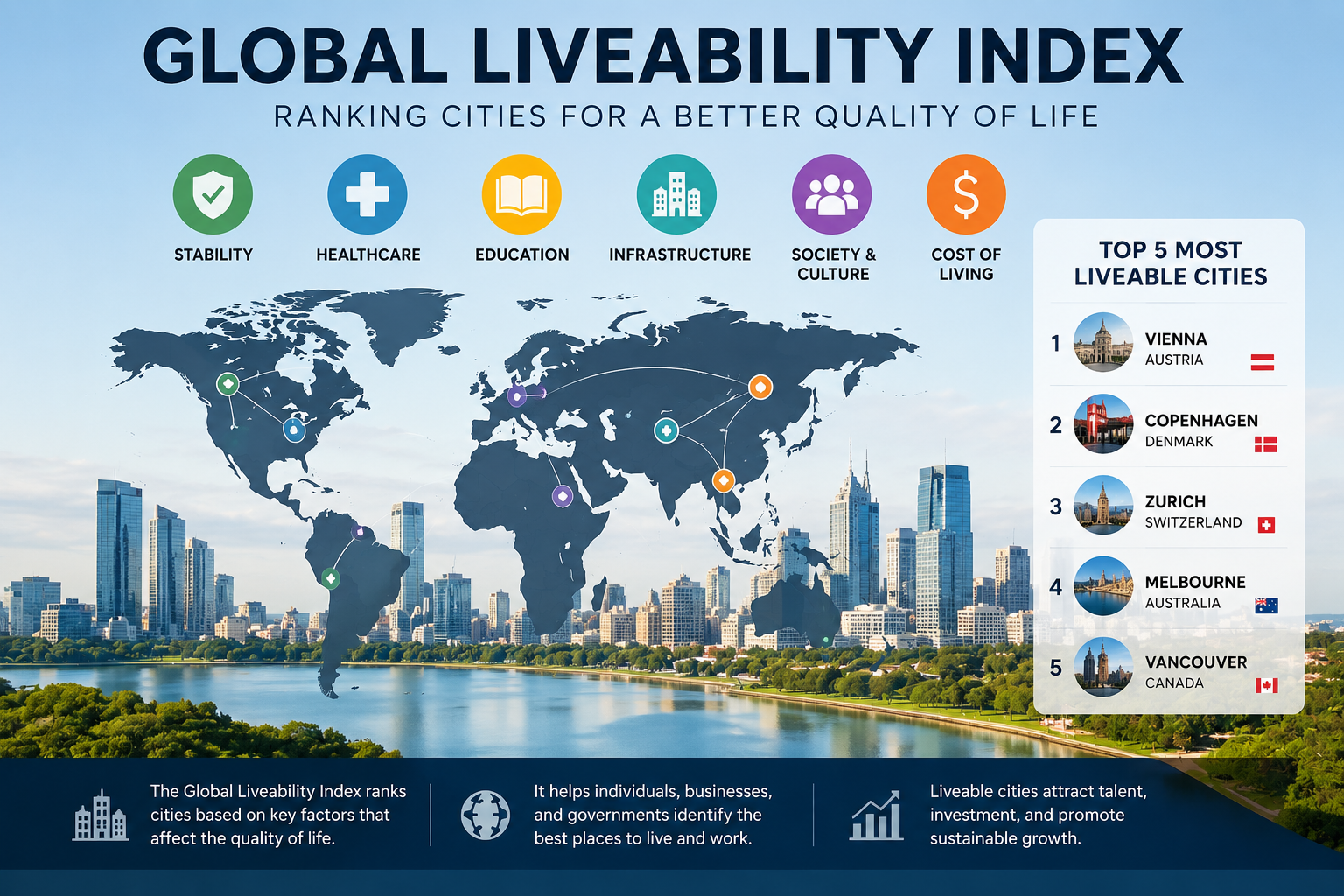
What makes a city a great place to live? It’s more than attractive buildings, high salaries, or popular tourist destinations. People also need reliable healthcare, good schools, safe neighborhoods, efficient transport, cultural opportunities, and strong infrastructure.
The Global Liveability Index provides a structured way to compare these qualities across major cities around the world. The index is particularly useful for people considering relocation, international study, business expansion, or simply wanting to understand which urban areas offer strong living conditions.
The Economist Intelligence Unit’s liveability research evaluates cities using several broad categories, including stability, healthcare, culture and environment, education, and infrastructure. The results provide a snapshot of how well cities support everyday life.
What Is the Global Liveability Index?
The Global Liveability Index is a city comparison framework associated with the Economist Intelligence Unit. It evaluates urban environments according to conditions that influence residents’ quality of life.
Rather than focusing only on economic performance, the index looks at practical aspects of living in a city.
These can include:
- Political and social stability
- Access to healthcare
- Cultural and environmental conditions
- Education
- Infrastructure
- Availability and quality of essential services
This broader approach explains why a wealthy city does not automatically become the world’s most liveable city.
How Does the Global Liveability Index Work?
The EIU’s approach evaluates cities across five major categories:
| Category | What It Examines |
| Stability | Safety, conflict, crime and social stability |
| Healthcare | Medical services and healthcare availability |
| Culture & Environment | Culture, recreation, climate and environmental factors |
| Education | Availability and quality of educational services |
| Infrastructure | Transport, utilities, housing-related infrastructure and connectivity |
Each category contributes to the overall assessment. The result is designed to show how comfortable and functional a city is for its residents.
The exact methodology and city coverage can change between editions, so readers should always check the latest published edition when using rankings for major decisions.
Key Factors That Make a City Liveable
1. Stability and Safety
A stable city gives residents confidence in their daily lives. Low levels of serious crime, political disruption, civil unrest, and conflict can significantly improve quality of life.
Safety also affects businesses, schools, tourism, and long-term investment.
2. Healthcare
Healthcare is another important part of urban liveability. Highly ranked cities generally have strong medical facilities, trained professionals, and reliable access to healthcare services.
Good healthcare becomes especially important for families, older residents, and international workers relocating abroad.
3. Culture and Environment
Liveability isn’t just about practical services.
Restaurants, museums, parks, public spaces, entertainment, sporting facilities, and cultural events can make a city more enjoyable.
Environmental conditions also matter. Air quality, climate, green spaces, and urban design can influence residents’ physical and mental well-being.
4. Education
A strong education system helps cities attract families, students, and skilled workers.
Schools, universities, vocational institutions, and access to educational opportunities can all contribute to a city’s overall attractiveness.
5. Infrastructure
Infrastructure keeps a city functioning.
Reliable public transportation, roads, utilities, telecommunications, and other essential systems make everyday life easier. Copenhagen, for example, is frequently highlighted for its cycling infrastructure and urban planning. Economist Impact has noted that more than 60% of Copenhagen commuters travel by bicycle and that the city has hundreds of kilometres of dedicated cycling lanes.
Most Liveable Cities in the World
Recent EIU liveability rankings have featured several cities from Australia, Europe, Canada, Japan, and New Zealand near the top.
A commonly cited recent top group includes:
| City | Country | Notable Strength |
| Copenhagen | Denmark | Stability, infrastructure and environment |
| Vienna | Austria | Healthcare, culture and infrastructure |
| Zurich | Switzerland | Infrastructure and quality of services |
| Melbourne | Australia | Healthcare, education and culture |
| Geneva | Switzerland | Stability and healthcare |
| Sydney | Australia | Culture, infrastructure and healthcare |
| Osaka | Japan | Stability and infrastructure |
| Auckland | New Zealand | Environment and education |
| Adelaide | Australia | Healthcare and lifestyle |
| Vancouver | Canada | Environment and infrastructure |
The exact order and scores should be checked against the relevant annual edition because rankings can change from year to year.
Why Copenhagen Often Performs So Well
Copenhagen provides a useful example of how liveability can result from long-term urban planning.
The Danish capital has invested heavily in cycling, public spaces, environmental initiatives, and sustainable transportation. Its approach demonstrates that infrastructure decisions can affect everyday experiences, from commuting to recreation.
Economist Impact has described Copenhagen’s transformation from a heavily car-oriented city into one where cycling plays a major role in daily transportation.
This also shows why liveability is not necessarily about having the largest economy. Urban planning and public services can have a major impact on residents.
Why Some Cities Perform Better Than Others
Cities that perform strongly usually have several advantages working together.
Strong Public Services
Reliable healthcare, education, transportation, and utilities create a foundation for comfortable living.
Effective Urban Planning
Good planning can reduce congestion, improve accessibility, create green spaces, and make neighborhoods easier to navigate.
Economic Stability
Stable economies can support investment in public services and infrastructure.
Environmental Quality
Clean air, parks, walkability, and climate resilience increasingly matter when evaluating quality of life.
Safety and Social Stability
People generally value cities where they can work, study, travel, and raise families without major security concerns.
Benefits of a High Liveability Ranking
A strong position on the Global Liveability Index can be valuable for several groups.
For residents: It can indicate access to better services and comfortable living conditions.
For businesses: Highly liveable cities may be attractive locations for recruiting skilled workers.
For students: Strong education and healthcare systems can make cities appealing destinations for international study.
For governments: Rankings can highlight areas where public policy and infrastructure need improvement.
For travelers and expatriates: The index can provide a starting point when comparing potential destinations.
Limitations of Liveability Rankings
No ranking can perfectly describe what life is like for every person.
A city may score highly overall but still be difficult for someone facing high housing costs, limited income, language barriers, or specific accessibility needs.
For example, a city with excellent healthcare and infrastructure may also have expensive housing. Another city may offer lower living costs but score less strongly in public transportation or healthcare.
Therefore, the Global Liveability Index should be treated as a comparison tool rather than a personal decision-maker.
How to Use the Index When Choosing a City
If you’re deciding where to live, study, or work, combine the index with your own priorities.
Follow these steps:
- Check the city’s overall liveability ranking.
- Look at individual category scores.
- Research housing and everyday living costs.
- Consider employment opportunities.
- Check transportation and commute times.
- Research healthcare and education options.
- Consider climate and environmental conditions.
- Think about your personal lifestyle and priorities.
This approach gives you a more realistic picture than relying on one ranking alone.
Global Liveability Index vs. Cost of Living
Liveability and affordability are not the same thing.
A highly liveable city can also be expensive. Zurich, Geneva, Sydney, Vancouver, and other major cities are examples of places where excellent services and infrastructure can coexist with significant housing and living expenses.
When comparing destinations, consider both:
- Quality of life
- Cost of living
- Average salaries
- Housing costs
- Healthcare expenses
- Transportation
- Taxes
- Employment opportunities
A city with a slightly lower liveability score may ultimately be a better choice if it matches your budget and lifestyle.
Key Takeaways
- The Global Liveability Index evaluates important aspects of urban life.
- Major categories include stability, healthcare, culture and environment, education, and infrastructure.
- Cities such as Copenhagen, Vienna, Zurich, Melbourne, and Geneva have featured strongly in recent EIU liveability rankings.
- Infrastructure and urban planning can significantly influence quality of life.
- A high ranking does not automatically mean a city is affordable.
- Rankings are best used alongside information about housing, employment, healthcare, education, and personal preferences.
- Liveability can change over time as cities respond to economic, environmental, and social challenges.
FAQs
What is the Global Liveability Index?
It is a system used to compare cities according to factors that influence residents’ quality of life.
Which city is the most liveable?
Copenhagen has been among the top-ranked cities in recent EIU liveability research.
What factors are included in the index?
The main areas include stability, healthcare, culture and environment, education, and infrastructure.
Is a highly liveable city always affordable?
No. Liveability and affordability are separate measures.
Why is infrastructure important for liveability?
Good infrastructure improves transportation, utilities, connectivity, and everyday convenience.
Can liveability rankings change?
Yes. City performance and ranking positions can change between annual editions.
Is the index useful for people moving abroad?
Yes. It can provide a useful starting point, but housing costs, jobs, visas, taxes, and personal needs should also be considered.
Conclusion
The Global Liveability Index offers a useful way to understand what makes cities comfortable, functional, and attractive places to live. Its focus on stability, healthcare, culture and environment, education, and infrastructure provides a broader perspective than economic statistics alone.
However, no ranking can capture every individual’s experience. Someone choosing a city for work may prioritize salaries and employment opportunities, while a family may care more about schools, healthcare, safety, and housing.
Learn About: Travel Mexico All Inclusive
