

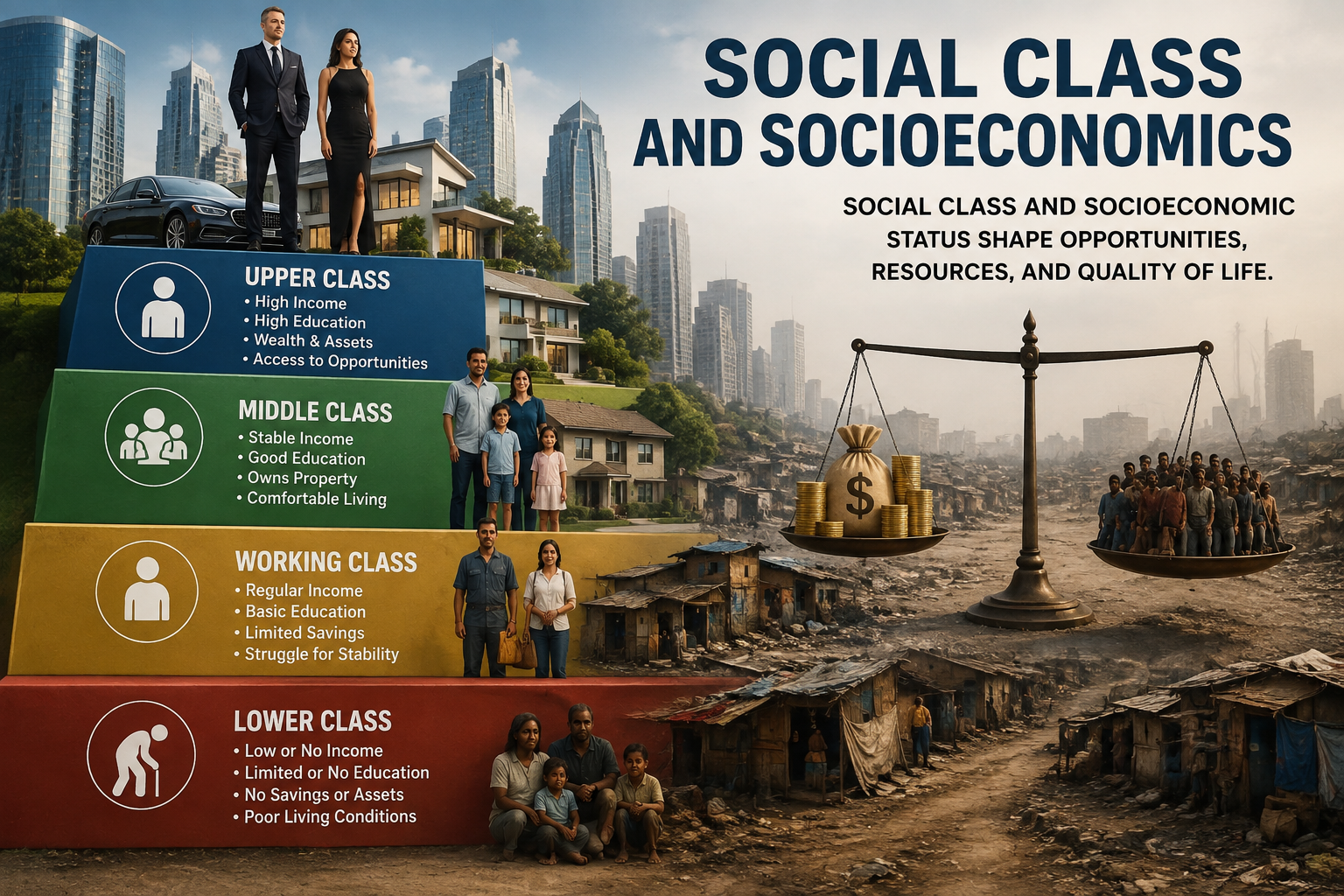
Why do people from different backgrounds often have very different opportunities, lifestyles, and experiences? One important part of the answer is social class and socioeconomics.
These concepts help explain differences in income, education, employment, housing, healthcare access, social networks, and overall quality of life. They are widely discussed in sociology, economics, education, public policy, healthcare, and social research.
Understanding these ideas isn’t simply about putting people into categories. It is about recognizing how economic resources and social circumstances can influence the choices available to individuals and families.
What Is Social Class?
Social class refers to a person’s or group’s position within a society’s social and economic structure. It can be influenced by wealth, income, occupation, education, family background, social connections, and access to resources.
Social class isn’t always determined by income alone. For example, two people may earn similar salaries but have very different levels of inherited wealth, housing security, education, or professional networks.
Sociologists may describe social class using broad categories such as:
- Working class
- Middle class
- Upper-middle class
- Wealthy or upper class
These categories aren’t universal. Their definitions can change depending on the country, research method, and historical period.
Social Class Is More Than Money
Money is an important part of social class, but it isn’t the whole picture.
Other influences can include:
- Educational background
- Type of employment
- Family wealth
- Housing conditions
- Social networks
- Job security
- Access to cultural and professional opportunities
This broader view helps explain why economic inequality can persist even when people have similar incomes.
What Does Socioeconomics Mean?
Socioeconomics examines the relationship between social conditions and economic factors. It looks at how resources, institutions, social background, and economic circumstances affect people’s lives.
A closely related term is socioeconomic status (SES). Researchers commonly measure SES using factors such as:
- Income or household resources
- Education
- Occupation
Depending on the study, researchers may also consider housing, employment security, neighborhood conditions, wealth, and access to essential services.
Socioeconomic research is useful because economic conditions don’t exist separately from social life. A family’s financial situation can influence where they live, which schools children attend, what jobs are accessible, and how much financial security they have.
Social Class vs. Socioeconomic Status
Although the terms are related, they aren’t exactly the same.
| Aspect | Social Class | Socioeconomic Status |
| Main focus | Position within a social hierarchy | Measurable social and economic conditions |
| Common factors | Wealth, occupation, education, social connections | Income, education, occupation |
| Use | Sociology and social analysis | Research, policy, education, health studies |
| Measurement | Can be broader and more interpretive | Often measured using specific indicators |
| Scope | Social and economic position | Social and economic resources |
In simple terms, social class is a broader concept, while socioeconomic status is often used as a more measurable way to describe social and economic circumstances.
Main Factors That Shape Socioeconomic Position
Income
Income affects a person’s ability to pay for housing, food, transportation, education, and other necessities.
However, income alone doesn’t tell the complete story. Two households with the same annual income may have very different financial situations because of differences in debt, savings, family support, or living costs.
Education
Education can influence employment opportunities, earning potential, and access to professional networks.
Educational advantages can also sometimes continue across generations when parents have the resources to provide tutoring, technology, extracurricular activities, or other forms of support.
Occupation
Occupation can reflect income, job security, working conditions, education requirements, and social status.
A stable professional position, for example, may provide different opportunities and protections than temporary or insecure employment.
Wealth
Wealth includes accumulated assets such as savings, investments, property, and businesses.
Wealth can be especially important because it may provide a financial safety net during unemployment, emergencies, or major life changes.
How Social Class Affects Everyday Life
Social class and socioeconomic conditions can influence many areas of daily life.
Education
Children from financially secure households may have greater access to educational resources, technology, extracurricular activities, and private support.
At the same time, public education systems and community programs can reduce some of these differences.
Housing
Housing is strongly connected to economic resources. Income and wealth can affect the size, location, quality, and stability of housing.
Neighborhoods can also influence access to transportation, schools, parks, employment, and other services.
Employment
People with greater educational opportunities and professional networks may have access to a wider range of jobs.
Economic background can also influence whether someone can afford unpaid internships, relocate for work, pursue additional qualifications, or take risks when changing careers.
Health
Socioeconomic conditions can be associated with differences in health outcomes. Factors such as income, housing, working conditions, education, food access, and healthcare availability can all contribute.
Importantly, socioeconomic status does not determine an individual’s health or future. It describes patterns across populations rather than predicting the experience of every person.
Social Mobility and Economic Opportunity
Social mobility refers to movement between social or economic positions.
For example, a person may experience upward mobility by obtaining higher education, entering a higher-paying profession, or building a successful business. Downward mobility can occur after events such as prolonged unemployment, major financial losses, or other economic disruptions.
Social mobility can be influenced by:
- Quality of education
- Labor-market conditions
- Family resources
- Geographic location
- Public policies
- Discrimination and social barriers
- Access to professional networks
- Availability of affordable housing and childcare
A society with greater opportunity for mobility may make it easier for people to improve their economic circumstances, although complete equality of opportunity is difficult to achieve.
Examples of Social Class and Socioeconomics
Consider two students who are equally talented academically.
Student A has reliable internet, a quiet study area, access to educational materials, and parents who can provide financial support.
Student B has similar academic ability but works part-time, shares a crowded home, and has limited access to technology.
Their individual ability may be similar, but their circumstances can affect how easily they can take advantage of educational opportunities.
Another example is employment. A worker with substantial savings may be able to leave an unhealthy workplace and search for a better position. Someone living paycheck to paycheck may have fewer options to make the same decision.
These examples show why socioeconomic analysis looks beyond individual choices and considers the circumstances surrounding those choices.
Why Understanding Socioeconomics Matters
Understanding social class and socioeconomics can help researchers, educators, businesses, and policymakers identify barriers to opportunity.
It can also improve decision-making.
For example, policymakers may use socioeconomic information when designing programs related to:
- Education
- Housing
- Employment
- Transportation
- Healthcare
- Childcare
- Financial assistance
For individuals, understanding socioeconomic factors can also encourage a more realistic view of economic inequality. Success and hardship are rarely caused by one factor alone. Personal decisions matter, but so do opportunities, institutions, resources, and circumstances.
Key Takeaways
- Social class describes a person’s broader position within society’s social and economic structure.
- Socioeconomic status commonly considers income, education, and occupation.
- Wealth, housing, employment security, and social networks can also shape socioeconomic position.
- Social class can influence access to education, employment, housing, and other opportunities.
- Socioeconomic status describes population-level patterns and doesn’t determine an individual’s future.
- Social mobility allows people to move between economic or social positions.
- Understanding socioeconomic differences can support better research, policy, and decision-making.
FAQs
1. What is social class?
Social class is a person’s or group’s position within a society’s social and economic structure.
2. What does socioeconomic mean?
Socioeconomic refers to the connection between social conditions and economic circumstances.
3. Is social class the same as income?
No. Income is one factor, while social class can also involve education, wealth, occupation, and social position.
4. What are the main measures of socioeconomic status?
Income, education, and occupation are commonly used measures of socioeconomic status.
5. Can socioeconomic status change?
Yes. Changes in income, education, occupation, wealth, or family circumstances can change a person’s socioeconomic position.
6. Why is socioeconomic status important?
It helps explain differences in access to resources, opportunities, living conditions, and outcomes across populations.
7. Does social class determine success?
No. Social class can influence opportunities and constraints, but it doesn’t determine an individual’s abilities, choices, or future.
Conclusion
Social class and socioeconomics provide useful ways to understand how economic resources and social circumstances interact. Income, education, occupation, wealth, housing, and social networks can all shape the opportunities available to individuals and families.
At the same time, socioeconomic background should never be treated as a fixed prediction of someone’s life. People can experience social mobility, overcome barriers, and follow very different paths.
The real value of socioeconomic analysis is its ability to reveal patterns that might otherwise be overlooked.
Learn About: Trump Approval
